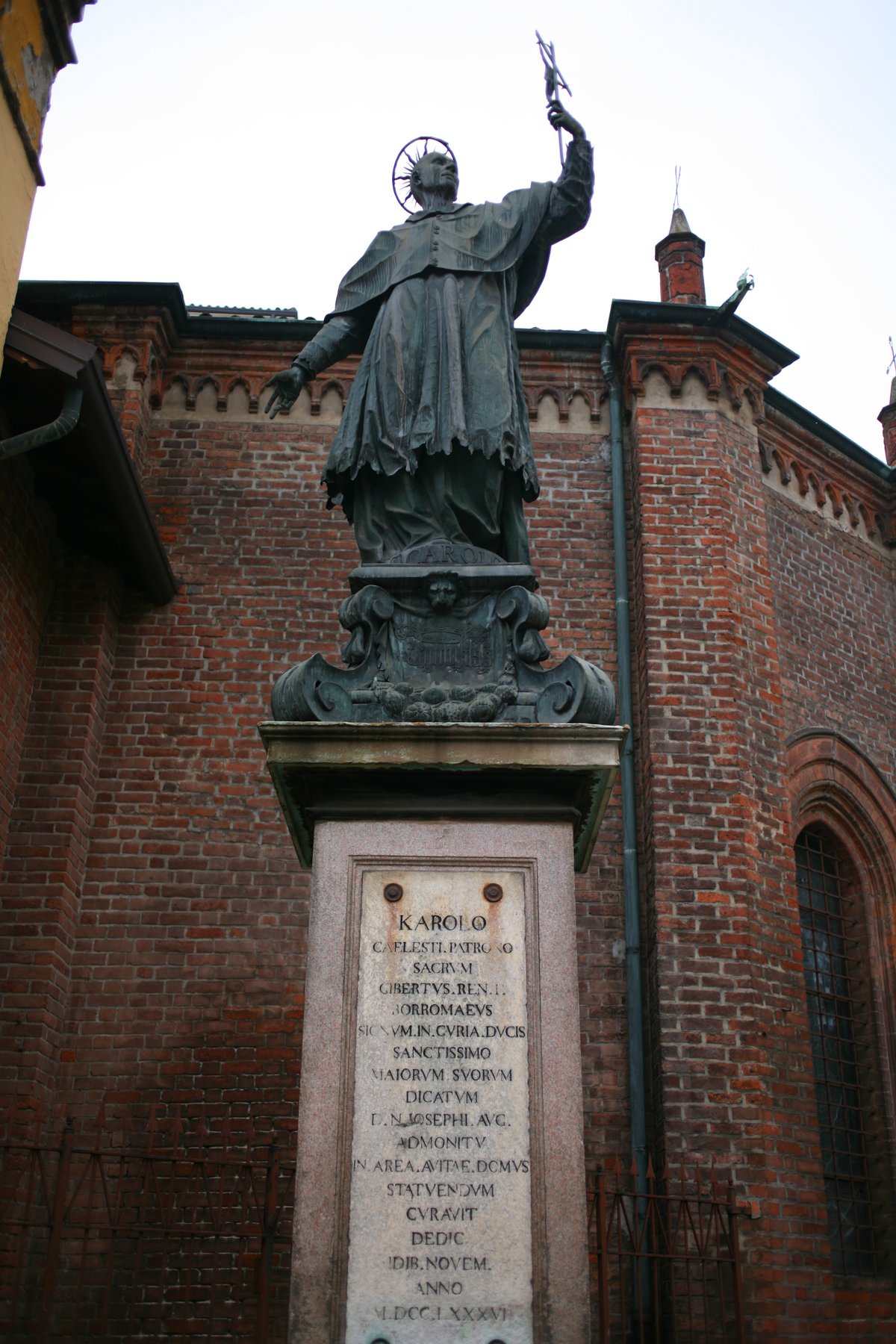

In 1786, the city of Milan established the dismantling of most votive crosses because they were considered an obstacle to traffic. While most were removed, the bronze and copper statue of San Carlo Borromeo was preserved. It was placed on a new base in Piazza Borromeo, situated between the Borromeo family palace and the church of Santa Maria Podone, of which the family held the patronage. This relocation is remembered by a plaque on the base, composed by the abbot Morcelli Bresciano at the request of Cardinal Vitaliano Borromeo.
The history of the monument began in response to a deadly plague. In 1577, a votive cross was created in Piazza Cordusio to replace one of the altars erected during the plague of 1576. The structure consisted of a marble column with a metal cross at the top, which was blessed in 1577. The base featured an inscription to commemorate the event.
The memorial underwent a significant transformation in 1610 following the canonization of San Carlo. The entire structure was redone with a new base and a statue of the saint in bronze and copper, designed by Dionigi Bussola. The monument was inaugurated by the archbishop Federico Borromeo, a cousin of San Carlo, in 1624 as noted by an inscription.
Sources: Wikipedia, OpenStreetMap, Wikidata, Wikimedia Commons
Written by Nicolo Ciampini
Discuss this with the author and others
No comments yet. Be the first to start the conversation.