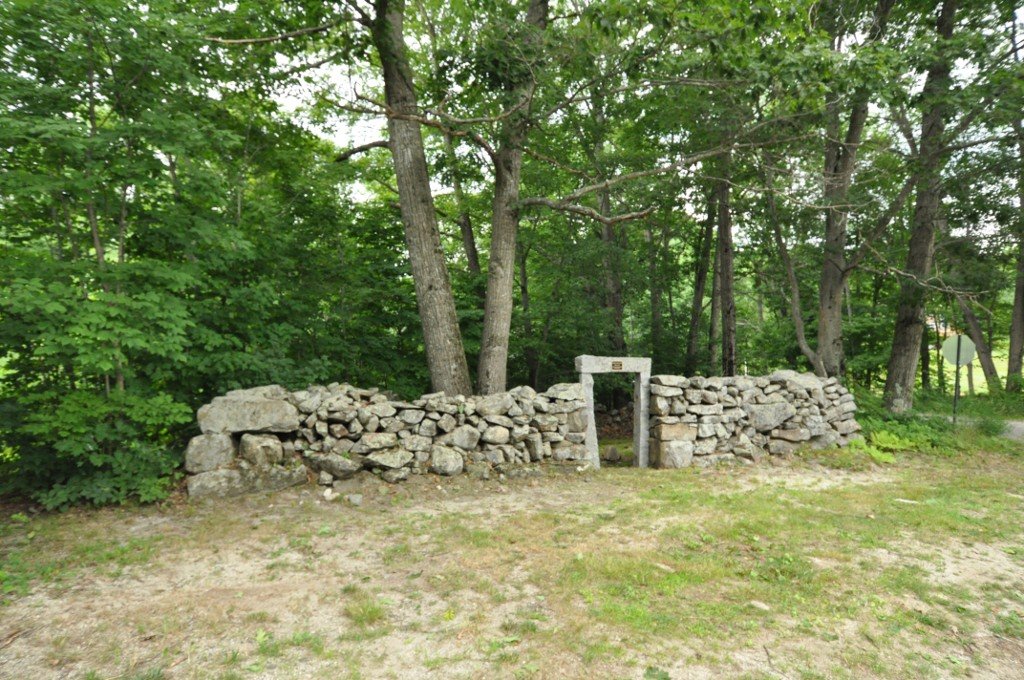

Think of this solid stone square as the old school way of handling stray livestock. Moses Merrill built this piece of 1816 engineering on land belonging to Cushing Phillips. It stands as a well-preserved example of a once-common feature of New England's agricultural communities.
Even though Turner became an official town in 1786, the people picked this specific spot because it was just that convenient. It sits right where two roads meet so everyone in the rural area could get there without a struggle. The walls are made of dry fieldstone stacked in irregular rows. These walls used to stand between 4 and 5.5 feet tall, but some sections have crumbled over the last couple of centuries.
If you lean in on the east side, you can spot the only way in. There are two upright granite posts with a lintel held together by metal pins. One post still shows the old metal pintles for a swinging gate, while the other has an eyebolt for a latch. It is a pretty cool way to see how public utilities worked back in the day.
Now, the Turner Cattle Pound is a solid piece of New England history that has survived the years. It made it onto the National Register of Historic Places in 2009. You can still find it as a heavy, quiet landmark at the corner of Gen. Turner Hill Road and Kennebec Trail.
Sources: Wikipedia, OpenStreetMap, Wikidata, Wikimedia Commons





Written by Friendly Jane
Discuss this with the author and others
No comments yet. Be the first to start the conversation.