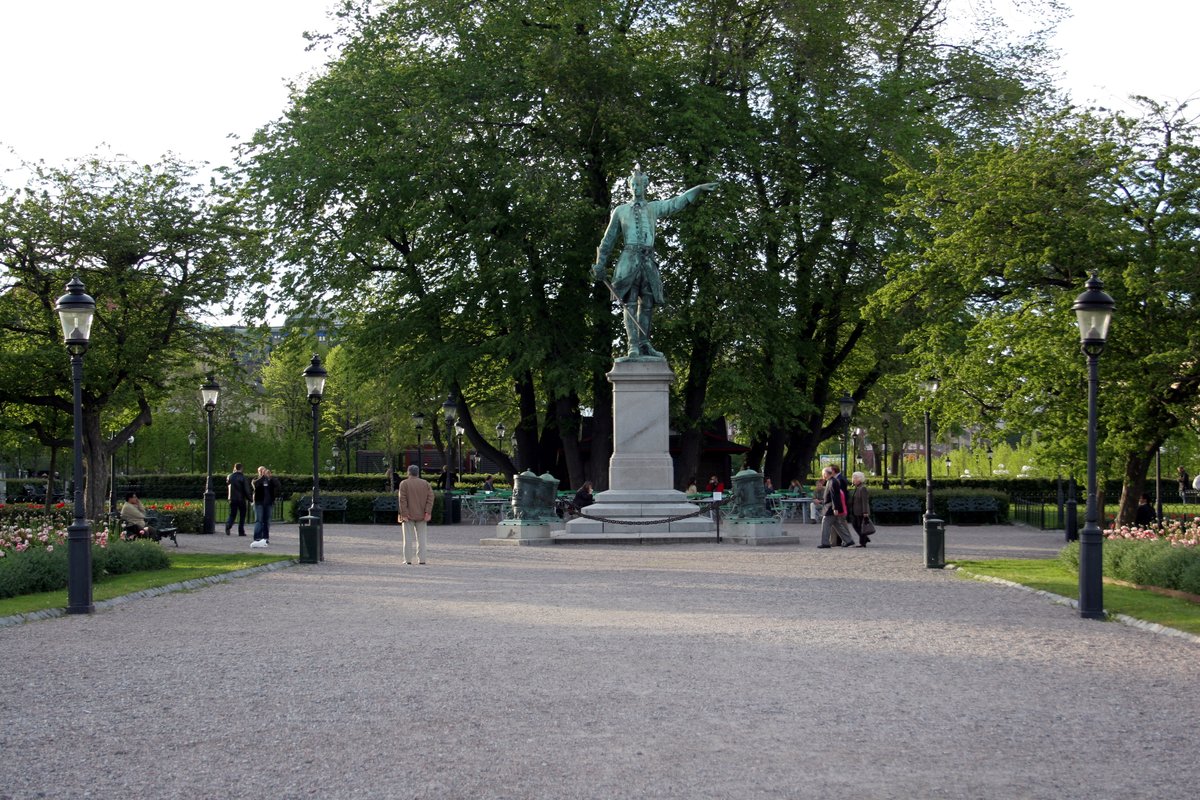

Karl XII's Square takes up the southern part of Kungsträdgården in central Stockholm. Here stands King Karl XII's statue - a work by Johan Peter Molin, unveiled in 1868. While the statue was officially unveiled on the 150th anniversary of Karl XII's death, it was actually 150 years and 2 months after his death. The statue shows Karl XII, holding a sword in one hand and pointing with the other towards the east. The statue was financed through a public collection and one of the requirements was that Karl XII's 'noble head' should be visible, although no mention was made in the source material that the statue was created without a helmet.
The statue was cast in bronze by the German foundry Lenz-Herold from Nürnberg, but the casting was done at the Royal Mint in Stockholm. A pedestal of Swedish granite supports the statue, and four mörsars, a type of artillery piece, surround it, connected by a chain of iron links. They were cast by Andreas Herold in Dresden in 1678 and were captured by Karl XII during the capture of Neumund during the Great Northern War against August the Strong, King of Poland and Elector of Saxony.
Each mörsar features a relief of Proserpin's abduction and the name Pluto. A sentence has been inscribed on each mörsar since: 'With God's Help, taken with the fortress Neumund, 11 December 1701'. The statue was dedicated under dramatic circumstances on November 30, 1868. The statue was financed through donations from the public and it is noted that August Blanche, who died on the way to the dedication, was involved in the proposal. Two grand receiving platforms were built for the royal family, court, government, diplomats, members of Parliament, civil servants and other high-status individuals.
At the last minute, the authorities decided to build a third receiving platform with a ticket price equivalent to a few days' wages for ordinary people, causing anger in parts of the press. A group of young men and boys attempted to gain access to the third reception platform, leading to a confrontation with the police. The situation escalated, and the authorities called in the military, who rode cavalry charges with cavalry whips against the crowd.
The authorities considered tearing down the platform, but were unable to do so in time. Disturbances in Kungsträdgården continued on November 29 and 30, but the dedication could be carried out as planned. Several participants and military personnel were injured during the riots.
Sources: Wikipedia, OpenStreetMap, Wikidata, Wikimedia Commons
Written by Nik Frost
Discuss this with the author and others
No comments yet. Be the first to start the conversation.