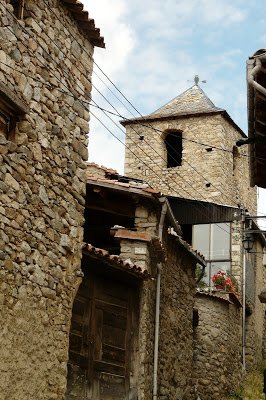

Located in the medieval heart of Músser, Sant Fructuós de Músser, known as Santa Maria de Músser, is a Romanesque church dating back to the 11th century. Associated with documentation from the end of the 10th century and the act of consagration of the Seu d’Urgell, this church features a rectangular nave with a semi-circular apse. The apse, on the exterior, displays cecal arcs and Lombardic pilasters that divide the tambour into five parts, dating back to the 11th century.
The entrance consists of three arches made of granite stone, with the first arch resembling a quarter circle. The entrance is similar to the side facade portals of the Catedral de Santa Maria de la Seu d’Urgell, dating from the mid-12th century. In the entrance arch, there is an inscription painted red: I DE MUSSA RESTAURADA 1958. The western facade once featured a monumental campanile, with the modern construction replacing it. The church still has a large baptismal font for immersion.
There are two curious fonts, called beneiteres, on either side of the entrance to the interior of the nave, each about 40 cm in diameter. The central part of the fonts presents rough stone faces carvings, which have yet to be fully interpreted. The church's interior contains oil paintings by Aurora Altisent and Balmas, painted in 1960, depicting scenes from the Creation. The church is protected as a cultural asset of local interest.
Sources: Wikipedia, OpenStreetMap, Wikidata, Wikimedia Commons
Written by Nik Frost
Discuss this with the author and others
No comments yet. Be the first to start the conversation.