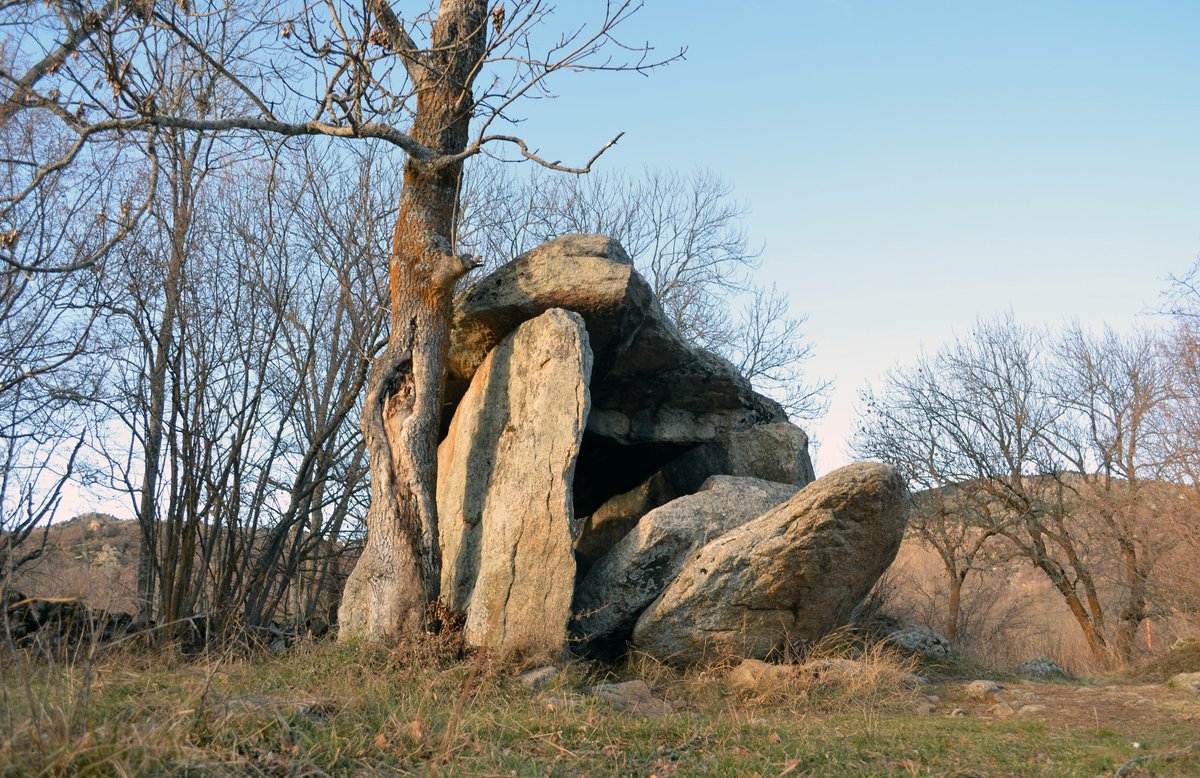

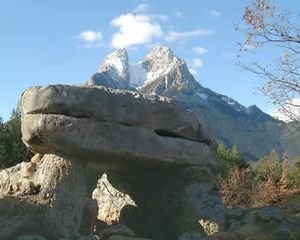
Located in the commune of Enveitg in the Pyrénées-Orientales department, the Dolmen de Brangolí is a megalithic site also known as the Dolmen d'en Caballer. It was first mentioned in 1921 by Pierre Vidal and was officially classified as a historical monument in 1976.
The dolmen is of the simple type, meaning it has no passage. The chamber is rectangular and defined by four orthostates made of local granite. The capstone is polygonal, measuring up to 3 meters in length, and features about thirty cupules (with six more on a fragment) carved with a rounded percussion tool. While the tumulus has been completely leveled by successive farming, some remains still persist on the east side.
Archaeological work on the site revealed that the dolmen has been looted for a long time. However, sieving the debris yielded some ceramic shards, a polished schist plaque, small flint lithic furniture including four arrowheads and a small blade, and a dark-colored glass bead. Analysis by mass spectrometry linked the glass bead to objects imported from the Near East starting from the Middle Bronze.
Sources: Wikipedia, OpenStreetMap, Wikidata, Wikimedia Commons
Written by Nicolo Ciampini
Discuss this with the author and others
No comments yet. Be the first to start the conversation.