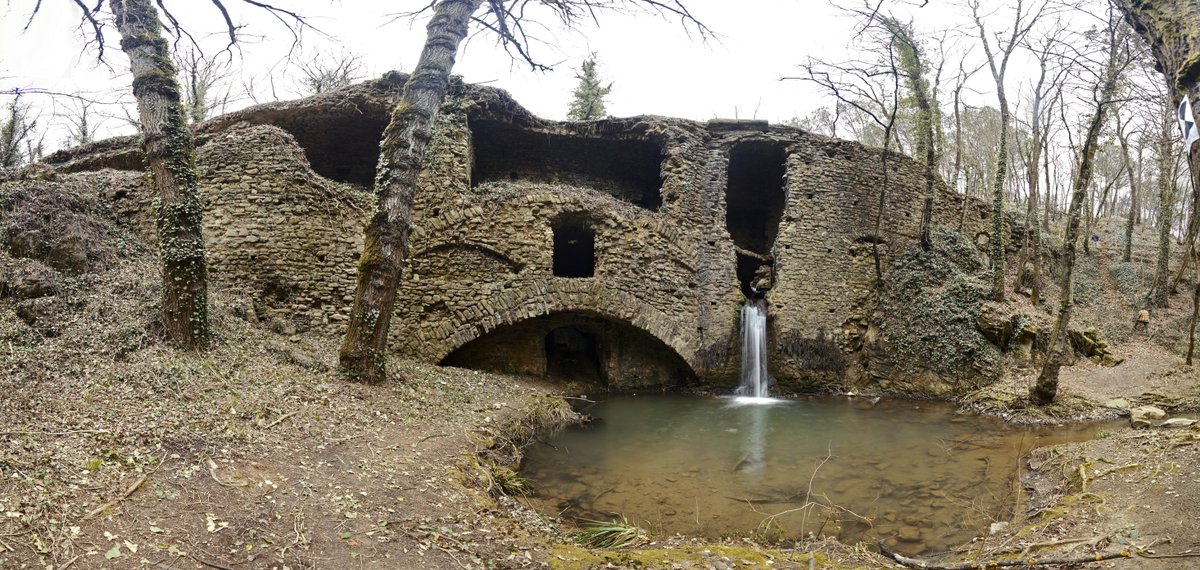

The Mulinaccio di Scandicci is a notable example of paleo-industrial architecture, located near San Vincenzo a Torri in the municipality of Scandicci. The structure began with a dam built along the Borro dei Lami in 1634 by the Galli family to create an artificial lake for a nursery. Several decades later, in 1648, a mill was added to the dam, and records show it was already operational by 1653.
Activity at the mill ceased by 1736, and by 1774, all operations had officially ended, likely due to new industrial grinding methods. In 1832 cadastral maps, the site was identified as a ruined mill and given the name Mulinaccio. While a lake remained behind the dam in 1833, it was drained a few years later. Today, the ruins of this imposing work continue to function as a bridge between the two banks of the valley.
The site is difficult to find because it is almost invisible from the outside due to thick vegetation. It is a semi-circular construction organized into three levels with large, partially collapsed round arches. Inside these arches, water still flows to power the stone millstones, some of which remain in place. Despite being precarious, it is still possible to walk through the barrel-vaulted corridor on the third floor.
Water flows through several rooms before escaping into the open to form a waterfall that crashes into a circular pool below. A few dozen meters further downstream, the ruins of a second structure are visible, featuring vaulted cisterns, gore, and millstones. The site can be reached via a one-kilometer trail from Villa I Lami or via a dirt road from Via Empolese.
Sources: Wikipedia, OpenStreetMap, Wikidata, Wikimedia Commons
Written by Nicolo Ciampini
Discuss this with the author and others
No comments yet. Be the first to start the conversation.