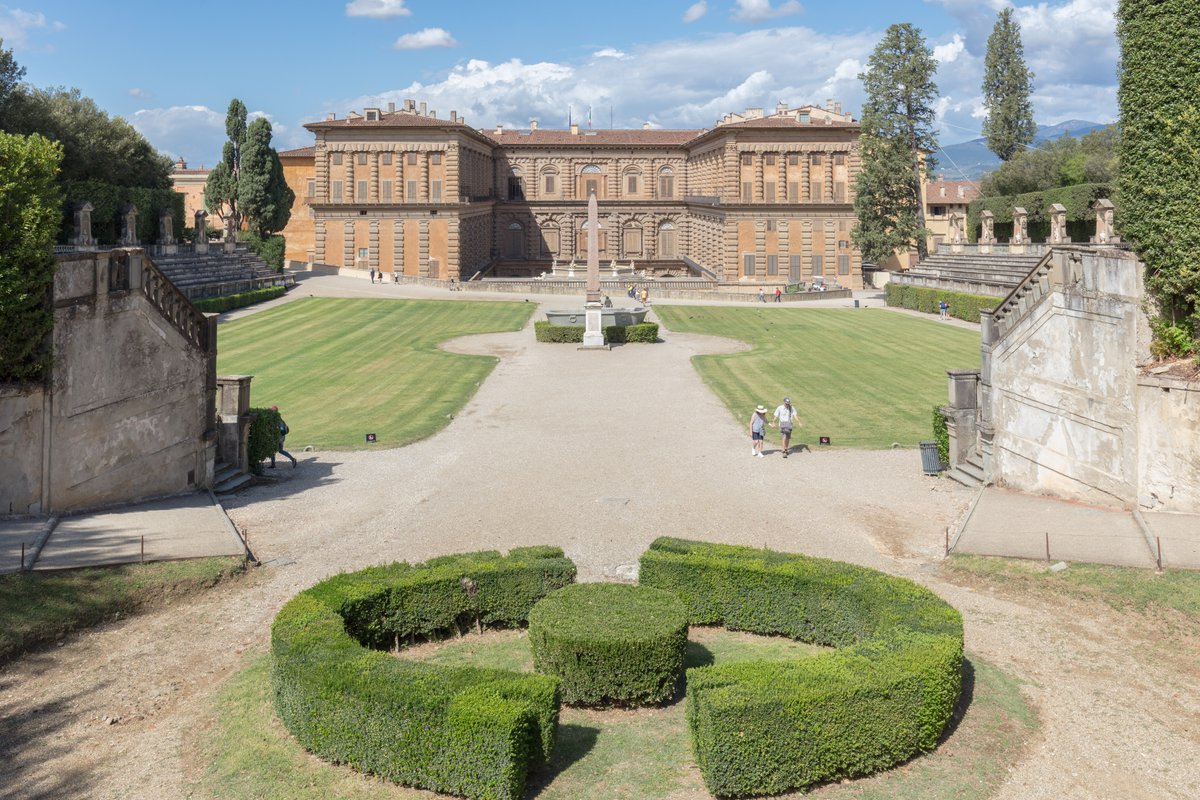

The Boboli Gardens in Florence was originally designed in the mid-16th century as the garden of the Medici family's Pitti Palace. As one of the first formal Italian gardens, it influenced aristocratic designs across Europe through its use of wide gravel avenues, lavish statuary, and large fountains. The gardens were notably private, with no access allowed to anyone outside the immediate Medici family, and no known parties or entertainment ever took place within the grounds.
Laid out for Eleonora di Toledo, the wife of Cosimo I de' Medici, the gardens were developed by figures such as Niccolò Tribolo, Bartolomeo Ammanati, and Giorgio Vasari. A primary axis rises from a deep amphitheater on Boboli Hill, featuring an Ancient Egyptian obelisk and a fountain of Neptune. Perpendicular to this is a long secondary axis known as the Cyprus Road, which leads through a series of terraces and water features toward the city gate at Porta Romana.
The gardens serve as an outdoor museum of sculpture, including works by Giambologna and the elaborate architecture of the grotto in the courtyard. One prominent grotto is divided into three sections, with one area originally frescoed to resemble a natural refuge for shepherds. This space once housed The Prisoners of Michelangelo, though they have since been replaced by copies. Water throughout the complex is supplied by an aqueduct funded by Cosimo I de' Medici in the late 1550s.
Sources: Wikipedia, OpenStreetMap, Wikidata, Wikimedia Commons


Written by Nicolo Ciampini
Discuss this with the author and others
No comments yet. Be the first to start the conversation.