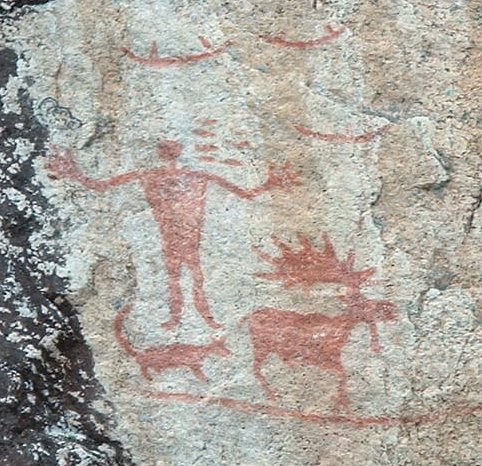

If you find yourself paddling around North Hegman Lake in Minnesota, keep your eyes peeled for the granite cliff face. If you look close enough, you can spot the faint red strokes left by the Ojibwe people. These pictographs are among the best-preserved examples in the state, dating back roughly 500 to 1,000 years.
Ojibwe shamans crafted these images using a specific recipe of red ochre mixed with iron hematite, boiled sturgeon spine, and bear grease. They applied the paint directly to the stone surface using their fingers. These figures were influenced by vision quests and show a deep spiritual connection to the natural world and animal brothers.
One figure with arms stretched out might represent the Winter-maker, which is the Ojibwe equivalent to the Orion constellation. Scholar Carl Gawboy has proposed that the pictographs may represent Ojibwe constellations, with other elements possibly depicting celestial patterns significant to Ojibwe astronomy and seasonal understanding.
Located within the Boundary Waters Canoe Area Wilderness, the Hegman Lake Pictographs are considered perhaps the most visited and photogenic pictograph within the State of Minnesota. The site remains a well-preserved example of Native American rock art on the granite cliff face.
Sources: Wikipedia, OpenStreetMap, Wikidata, Wikimedia Commons
Written by Friendly Jane
Discuss this with the author and others
No comments yet. Be the first to start the conversation.