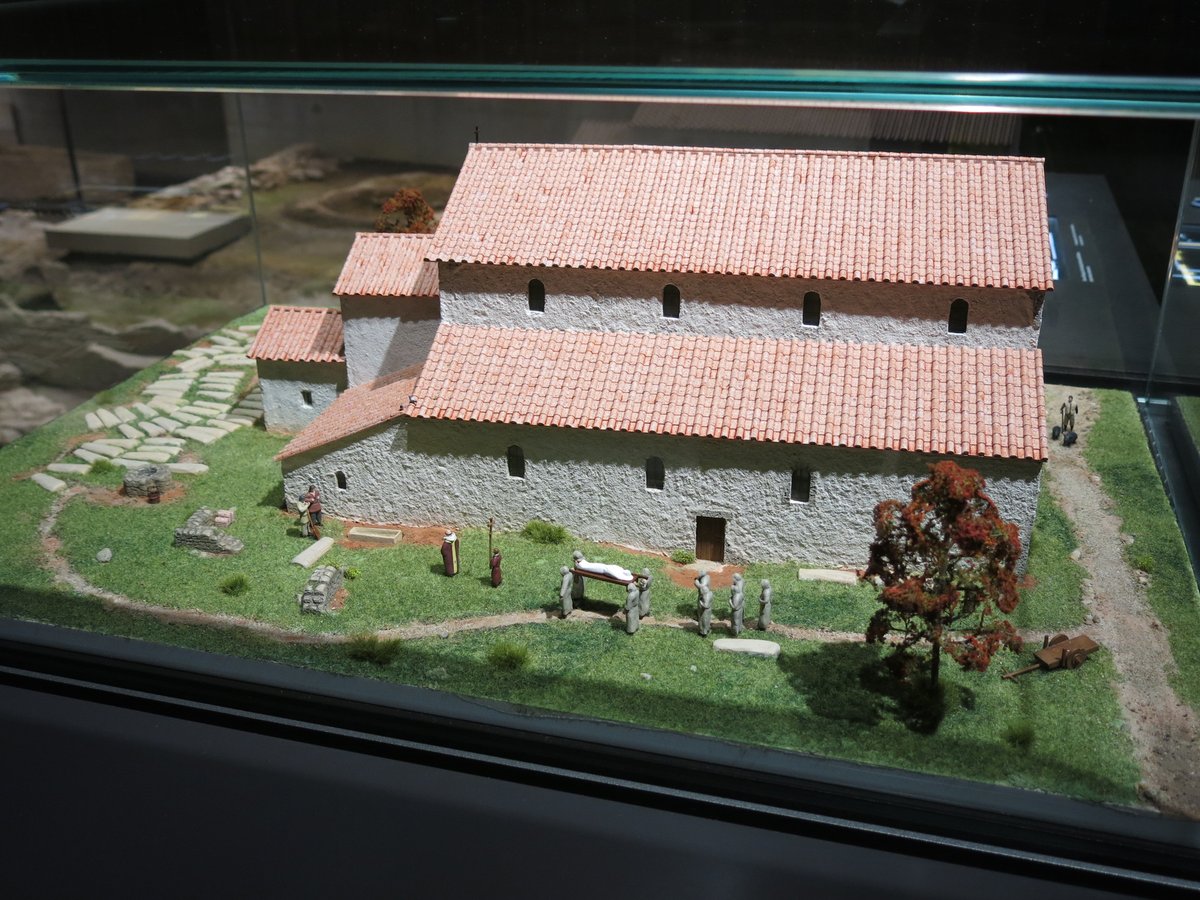

Located in Luxeuil-les-Bains, Haute-Saône, France, the Church of St. Martin has a long and rich history dating back to the Roman era. The most ancient stone building found on the site dates back to the 2nd century with a domus, an urban residential building of the lavish Roman villa type. However, by the 4th century, this building was abandoned, and a pagan necropolis was established. This change was likely due to the reduction in size of the ancient Roman city, possibly to make way for a castle, whose exact boundaries are not known.
The necropolis was followed by the construction of the church itself, which was established in the 12th/13th centuries. The church underwent several changes, including a reconstruction at the beginning of the 9th century, incorporating early sarcophagi and an abside with a memorial character. The church eventually evolved from its monastic function to a parish function.
In 629, Saint Valbert, a hermit, was selected to lead the monastery, and he was later buried there in 668. His burial site became a pilgrimage site and a place of burials. The site was classified as a historical monument in 2010, and the remains of the church were discovered in 2006 during a parking construction project.
In 2018, a centre for interpretation and animation of the archaeological site was created, designed by Michel Malcotti.
Sources: Wikipedia, OpenStreetMap, Wikidata, Wikimedia Commons
Written by Nicolo Ciampini
Discuss this with the author and others
No comments yet. Be the first to start the conversation.