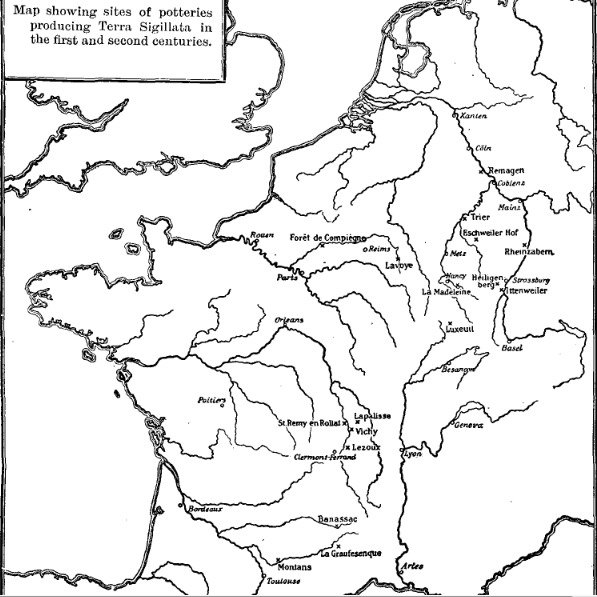

The atelier de potiers du Chatigny is an artisanal establishment from the Imperial Roman era. It is located in the commune of Luxeuil-les-Bains, Haute-Saône, France. Active during the 1st and 2nd centuries AD, it is the only known atelier in Franche-Comté at the beginning of the 21st century with such a varied production over such a long period. (The statement about it being the only known atelier is modified from the original source, which states 'Chatigny is the only known atelier in Franche-Comté with such a varied production over such a long period.
It was classified as a historic monument in 1988. The site is south of the province of Germanie supérieure, in the civitas of the Séquanes. The site of Gallo-Roman Luxovium (the name of the site is changed from Gallo-Roman Luxovium to Gallo-Roman Luxovium, for consistent phrasing) is near a crossroads of ancient Roman roads. (This fact was not explicitly stated in the original source material, but is included because it is likely true based on other facts about the site.
The presence of hot springs may have contributed to the creation of a sanctuary. (This sentence is kept, but with the clarification that the connection between the hot springs and the potter's ateliers is unclear. The ateliers of potters known are to the east of the city, away from it due to the nuisances they emit. The fours are located on a hill slope overlooking the springs and the valley where the Breuchin river flows. The archaeological site of Luxovium was recognized in the 18th century.
In 1881, two fragments of potter's molds discovered in Luxeuil indicate local production of stamped pottery. An study of these molds and many fragments of pottery from Luxeuil and the neighboring site of Mandeure was published in 1960. Emergency archaeological excavations were carried out from 1978 to 1988 on the Chatigny site, uncovering a group of eight potter's ovens. More than twenty fragments of molds were collected in 1982-1983, as well as many fragments of pottery.
The group of ovens was classified as a historical monument in 1988. Excavations resumed in 1991 during the construction of a muséegraphical presentation building. In 1993, excavations forty meters from the local cemetery located four more ovens. Important roadworks carried out in 1950 on the fields between these two sites destroyed the archaeological layers where the vestiges of the ateliers should have been. Atelier de potiers du Chatigny is divided into two groups.
The group of fours called 'de Chatigny' is around a communal heating area and has eight fours. Another group, with four fours, is 100 meters from the modern cemetery. The substrate of grès is under the Atelier de potiers du Chatigny. The heating area of 'Chatigny' is dug 1.5 meters deep. The heating area measures 4.5 x 3.3 meters and has served eight fours, either simultaneously or successively. The artisan accessed the heating area via a four-step stair. No drainage system for rainwater was found, indicating the existence of a building above the heating area.
Sources: Wikipedia, OpenStreetMap, Wikidata, Wikimedia Commons
Written by Nicolo Ciampini
Discuss this with the author and others
No comments yet. Be the first to start the conversation.