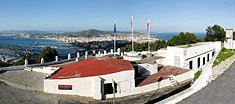

Facing the sea, at the very edge of the Upper Rock, in the British Overseas Territory of Gibraltar - Princess Caroline's Battery is named for two princesses, one long-remembered and another all but forgotten. Removed from the battlefield and open today as a tourist attraction, it is a piece of Gibraltar that both lost and won the Great Siege of 1783-84.
Princess Caroline's Battery is named after error: it is often confused with adjoining, less famous Princess Anne's Battery. The barrage of that name belongs to Princess Anne, daughter of George II, but this one - like its pair - was named for the daughter of George III: Princess Caroline Mathilde of Great Britain and Wales.
The battlements that stand marked as a memorial today are physically and metaphorically the gateway to the Upper Rock, the cliffs that rise steeply from the southern end of the Strait of Gibraltar to the 14 Geodesics. The batteries commanded a view of the waterside and the approach from the sea, warning of any blockading fleets. As such, it helped defend Gibraltar during the Great Siege.
In the summer of 1783, following Admiral Keppel's surprise victory at the Battle of the Gulf, Britain's enemy fleet massed for an invasion. The Royal Navy's commander in Gibraltar, Commodore Martin, had only forty-two ships to watch for this and seal off the strait, so he built a line of defences and focused on holding out. That line stretched from Europa Point on the other side of the Rock to John Mackinnon's Battery on the northern cliffs.
The Great Siege lasted from August 1782 to February 1784. The Clash of the Titans it was not, but even so, when the 70-day truce was broken and fighting began anew on August 1st, 1783, it was with heavy hearts that the British watched their line start to crumble under a relentless onslaught. The fleet blockading the entrance to the Bay of Gibraltar was too strong, and the supply line was being strangled. If the British held on, the fleet would be resupplied - but the fleet's supplies would be able to reach the town. The Gibraltar forces would be conquered, and the Rock surrendered.
The British reinforced their line where they could, sometimes with little more than sandbags and barrels. The rest had to rely on planning, leadership, and good luck. Princess Caroline's Battery shared one of the key duties of the Upper Rock, wary as it was. Between them, it and Princess Anne's Battery covered the bay, shelling the enemy with guns placed and fired on the western cliffs of the rock - a long range of fire but one nonetheless. They were as ready for a long war as anyone else on the line, and they fought as hard as anyone.
While the British held on, the Spanish formed a fleet and attempted an invasion by water. The British fleet managed to keep them at bay, and the hapless infantry regiments of Spain suffered heavy losses to cannon fire.
As the summer wore on, more troops were brought to bear against Gibraltar. By the end of the year, the British line was again in danger of breaking and succumbing to starvation. The tides of war turned, fortunes reversed, and the British were finally able to break the siege at the end of February 1784.
There was still work to be done before Gibraltar was truly safe. Princess Caroline had survived - but had it been bombed, it would have fallen. The batteries on the Upper Rock had weathered the siege - but they were worn, and their walls were scarred. There was work to be done to secure the fortification and supply it with the resources it could no longer manufacture on site. Women, the elderly, and the injured were sent away, bringing the total civilian population down to 1,092 throughout the siege, and to a low point of just 394 in February 1784. By August 1785, the city had been restored enough to welcome back some of the refugees who had left. The citymen returned and found their homes lived in by strangers, although the plague had passed.
[The rest of Gibraltar's story is not over.]
Princess Caroline's Battery is now under the care of the Gibraltar Tourist Board, though it is run daily by a private company. It is a small museum, with displays of weapons and artifacts from its days amid the conflict. The exhibition features a memorial chamber in its magazine, commemorating those who fought at Princess Caroline and throughout Gibraltar's history.
Sources: Wikipedia, OpenStreetMap, Wikidata, Wikimedia Commons
Written by Nik Frost
Discuss this with the author and others
No comments yet. Be the first to start the conversation.