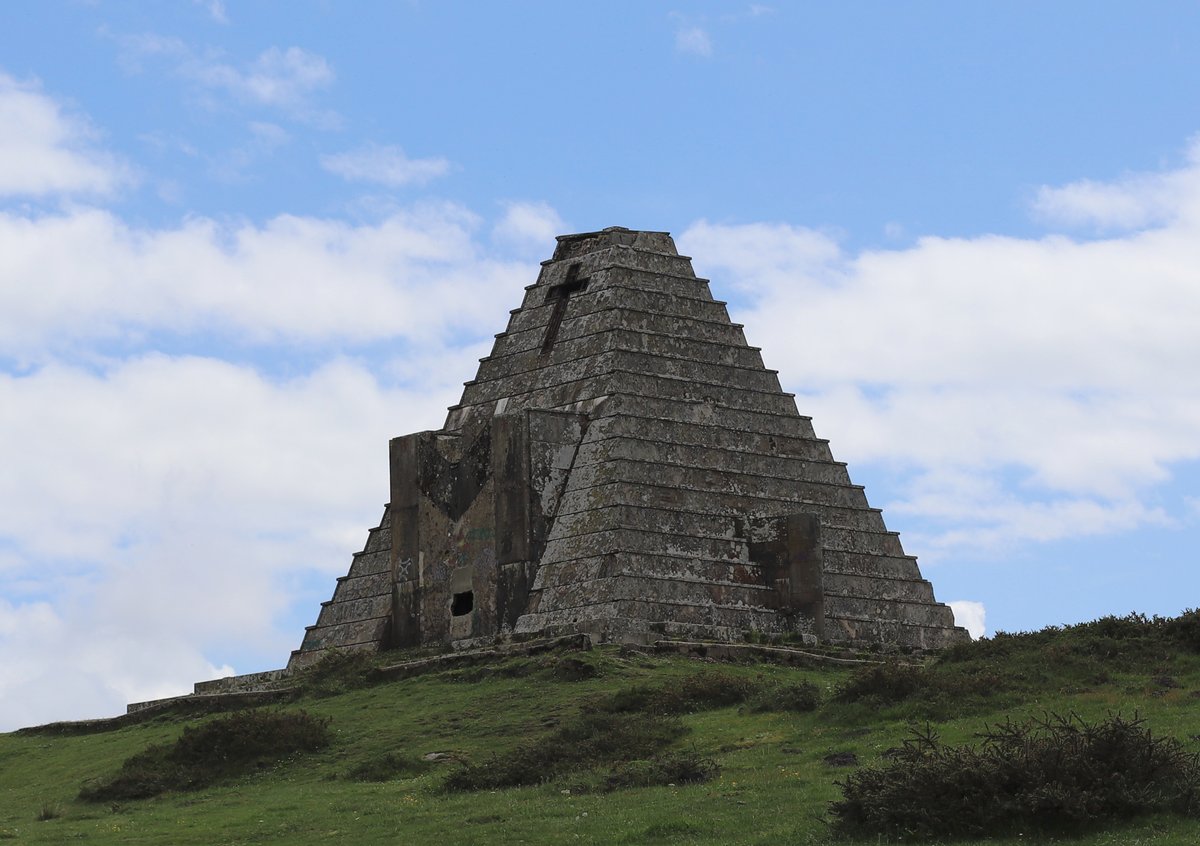

The Pyramid of Puerto del Escudo, located in the province of Burgos, Spain, was constructed in 1937 to serve as a mausoleum for Italian soldiers who died in the Battle of Puerto del Escudo. The pyramid, originally designed to house the bodies of the fallen soldiers, was conceived by Lieutenant Attilio Radic, a Dalmatian architect who supported the Fascist party. The Italian Ministry and the Francoist regime approved the construction of the pyramid.
Frail Pietro Bergamini di Varza directed the operation for the construction of the pyramid. Radic and Bergamini completed the construction in 1939. Galeazzo Ciano, the Italian Minister of Foreign Affairs, supervised the burial of the Italian Fascist soldiers. In May 1971, an Italian military bus carrying approximately 50 Italian soldiers and family members crashed near the pyramid, causing 12 deaths and 23 injuries. Since the accident, the location has been known as the Curva de los Italianos.
In 1975, the Italian government decided to exhume the bodies, with 268 bodies being repatriated and the rest being moved to the church of San Antonio de Padua in Zaragoza. The pyramid has been abandoned since 1975 and has suffered from deterioration and vandalism. Before 2023, the pyramid's old political symbols were removed. Today, the pyramid measures 10 meters in height and is made of concrete covered with stone slabs. The base is square with four slanted triangular planes, two stepped and two smooth, with its sides not meeting at a vertex but at a small platform where a statue of the Winged Victory was originally planned but never executed.
The entrance to the monument is framed by a giant capital M, which some interpret as a reference to Mussolini, while others believe it reflects its mortuary function, resting place of the remains of Italian soldiers. Access to the pantheon is through a wrought iron gate with geometric motifs, closed with a polished crystal decoration with references to war and nature. A circular chapel covered by a semi-sphere with a lantern allows natural light to enter through cross-shaped claraboyas.
The circular space functions as a columbarium with 360 niches for the ashes of Italian soldiers of the Corpo Truppe Volontarie, which cover the entire surface of the cylinder's wall. An iron staircase leads to the subterranean crypt created to bury 12 fallen officers. The structure is characterized by its austerity and functionality, devoid of ornamentation. In the entrance, the phrase 'Presente' is repeated three times in memory of the fallen soldiers.
On the south side, there is an inscription that plays with the word 'escudo', referring to the battlefield and a Latin Bible verse: 'Psalm 141:5, Escutum meum confortare. The style of the pyramid presents eclectic features, with clear influences from the avant-garde between the World Wars. The work can be defined as brutalist, a style widely appreciated in Fascist Italy for its solidity, simple lines and austere materials. The rigid, geometric shapes and ornament-free forms follow the trend of rationalist architecture, combining sobriety with the monumentality of the work, fulfilling the Fascist desire for exaltation.
The Pyramid of the Italians was declared a cultural heritage with the category of monument by the Junta de Castilla y León on February 29, 2024. The decision was supported by the Italian party Fratelli d'Italia, led by first minister Giorgia Meloni.
Sources: Wikipedia, OpenStreetMap, Wikidata, Wikimedia Commons
Written by Nik Frost
Discuss this with the author and others
No comments yet. Be the first to start the conversation.