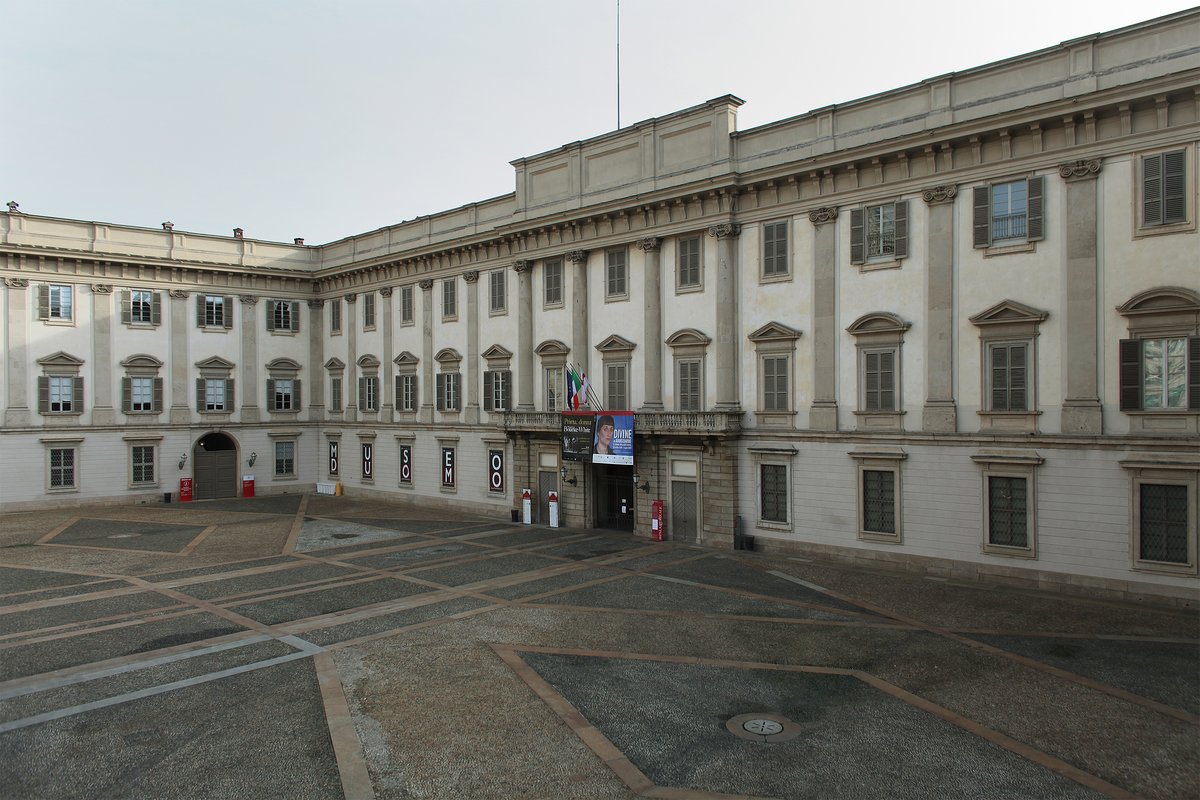

The Royal Palace of Milan (Palazzo Reale) was the seat of government in the Italian city of Milan for many centuries. It sits to the right of the Duomo's façade, opposite the Galleria Vittorio Emanuele II. The façade of the palazzo creates a recess in Piazza del Duomo which functions as a courtyard, known as the Piazzetta Reale - a "Small Royal Square".
It wasn't always this elegant. It started as the Palazzo del Broletto Vecchio, a medieval seat of the city's government. Under French rule, the court was moved to Palazzo Reale because the Castello Sforzesco had become a fortress more apt for warfare than an elegant residence. The Gonzaga family later refurbished and transformed the ducal court into a palace suitable for a governor, demolishing the old church of Sant'Andrea al Muro Rotto to annex its land. They also created an interior passageway in an enclosed courtyard to connect the royal palace to the Church of San Gottardo, which became the official church of the court.
The palace also housed a theater. The first Court Theater was completed in the late 16th century and was the first of a series of theaters built in Milan, but it burned down in 1695. A new ducal theater was designed by Francesco Galli Bibbiena and his pupils, and it was completed in 1717. That theater was larger, with four tiers of boxes and a gallery in the shape of a horseshoe - on the side was a small ridottino for gambling and a shop for drinks, sweets and costumes. A fire in 1723 also damaged the ceremonial halls of the palace.
Today, the palazzo is a cultural centre and a massive art hub covering 7,000 square meters. More than 1,500 masterpieces are on display annually. The Hall of Caryatids, located on the main floor, was heavily damaged by World War II's air raids. After the war, the palazzo remained abandoned for over two years and its condition further deteriorated. Many of the palazzo's neoclassical interiors were lost in this period.
Sources: Wikipedia, OpenStreetMap, Wikidata, Wikimedia Commons

Written by Nicolo Ciampini
Discuss this with the author and others
No comments yet. Be the first to start the conversation.