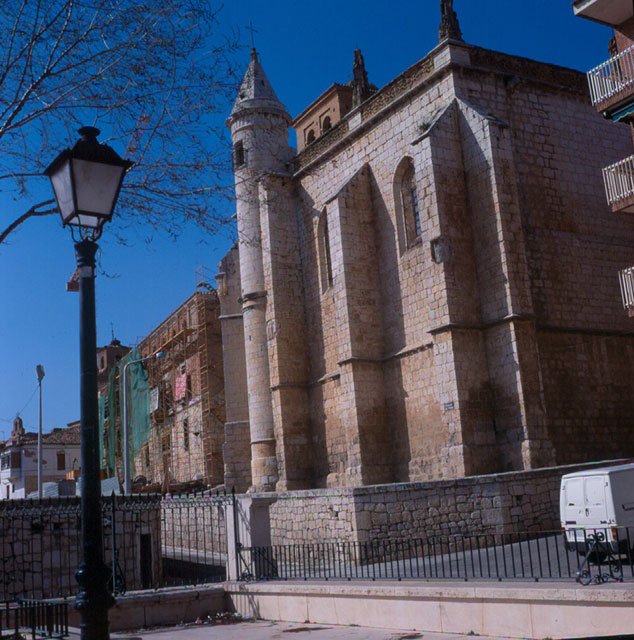

Step into the past and visit the Iglesia Museo de San Antolín in Tordesillas, a testament to the rich cultural history of Spain. The church, dating back to the 16th century, was founded by Pedro González de Alderete and has since undergone numerous renovations, the most recent in 1969 when it was transformed into a museum. The museum's collection consists of various art pieces from other churches, showcasing a variety of styles and periods. The oldest part of the building, the chancel and the Alderete family chapel, were built in the mid-16th century.
Pedro González de Alderete, a wealthy nobleman, commissioned the construction of these parts. The tower, made of brick, is another significant element of the building. The church was constructed between the 16th and 17th centuries and was finished by Gil de Reynaltos in 1644. In 1712, Juan López painted the choir. During the 18th century, consolidation work was carried out on the tower. The church has a single nave with cross-vaulted ceilings and Baroque ornamentation of the 17th century.
It has a baptistery, a pulpit, the Acebedo chapel, a lower choir, and an upper choir. Various altars of interest are displayed. The main altar is from 1658, with paintings by Felipe Gil de Mena. The separate pieces are quite valuable, including works by Gregorio Fernández, Pedro de Mena, Francisco Salzillo, and others. The pieces of jewelry and liturgy are also interesting. The Acebedo chapel has a plateresque railing attributed to friar Francisco de Salamanca.
There is a sepulcher of don Pedro González de Alderete, made by Gaspar de Tordesillas in 1550. The sepulcher of Rodrigo de Alderete is attached to the wall below a barrel-vaulted arch, flanked by Gothic spires. The Capilla de los Acebedo contains paintings from the early 16th century and some sculptures of interest. The Cristo yaciente in the nave central is from the second half of the 17th century, from the workshop of Gregorio Fernández. The Capilla de los Alderete houses a plateresque grille from the 16th century, attributed to friar Francisco de Salamanca.
The Retablo plateresco in the Capilla de los Alderete is attributed to Juan de Juni from the 16th century. The Sepulcro de Pedro de Alderete, in the Capilla de los Alderete, is from 1550 in the Plateresque style, by Gaspar de Tordesillas. The Sepulcro de Rodrigo de Alderete is from the 16th century. The Cuadro de San Antonio in the Capilla de los Alderete is by Alfonso del Arco. The mueble cajonero in the Capilla de los Alderete is from the 16th century.
The Cuadro de la escuela de Murillo in the Capilla de los Alderete depicts the boda de la Virgen María y San José. The Cristo cruficado in the Sacristía is from the 16th century, in the Gothic style. The Talla de la piedad in the Sacristía is from the 15th century, in the style of the master of San Pedro de la Moraleja. The Facistol and mesa de nogal in the Tribuna are from the 16th century. The Retablo central in the nave central, by José Arroyo, was realized in the 17th century and decorated in 1633 by Felipe Gil de Mena.
The Retablos laterales in the nave central have images of San José and San Francisco. The Retablo portátil in the nave central is from the 16th century. The Cristo yaciente in the nave central is from the 16th century, from the school of Gregorio Fernández. The Sagrada familia in the nave central is from the same school as the Cristo yaciente. The Retablo del siglo XVI in the Capilla de los Ulloas is originally from the 16th century. The Sepulcro de finales del siglo XV in the Capilla de los Ulloas is originally from the 16th century.
The Bóveda estrellada with a Calvario in the Capilla de los Acebedo is originally from the 16th century, with the Cristo attributed to Francisco del Rincón and the figures of the Virgen and San Juan attributed to Gaspar de Tordesillas. The Retablo de pintura y talla in the Capilla de los Acebedo is originally from the 16th century.
Sources: Wikipedia, OpenStreetMap, Wikidata, Wikimedia Commons
Written by Nicolo Ciampini
Discuss this with the author and others
No comments yet. Be the first to start the conversation.