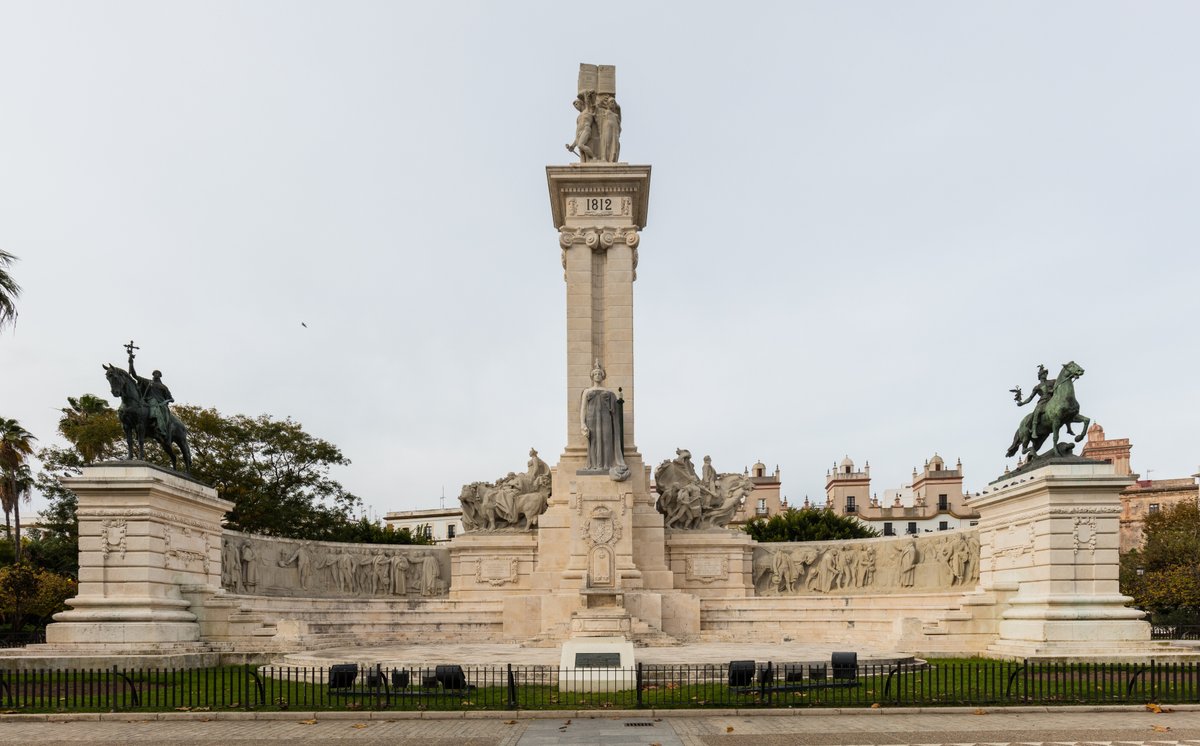

In the Plaza de España, the Monument to the Constitution of 1812 stands as a marble testament to a brief legal framework. Although the city commissioned the structure in 1912 to celebrate the centennial of the Constitution, the construction process spanned seventeen years before it was completed in 1929.
During the Peninsular War, Cádiz was one of the few free Spanish cities. It was within these walls that the Cortes drafted a charter that had a significant impact on nationalism and liberalism throughout Western Europe and the Americas. Though the Constitution was briefly in effect between 1812 and 1814, and again between 1820 and 1823, it left a lasting historical mark.
Designed by Modesto López Otero and sculpted by Aniceto Marinas, the monument uses allegorical figures to convey its message. The lower level represents a chamber with an empty presidential armchair, while the upper level features inscriptions. Bronze figures representing peace and war stand on each side. In the centre, a pilaster symbolizes the principles of the 1812 constitution, flanked by a female figure representing Spain and sculptural groupings representing agriculture and citizenship.
While many other monuments to the Constitution of 1812 were erected throughout the Spanish-speaking world, many were destroyed through subsequent regime changes. Remaining structures can be found in locations such as Mexico City, Montevideo, Comayagua, and St. Augustine.
Sources: Wikipedia, OpenStreetMap, Wikidata, Wikimedia Commons
Written by Nik Frost
Discuss this with the author and others
No comments yet. Be the first to start the conversation.