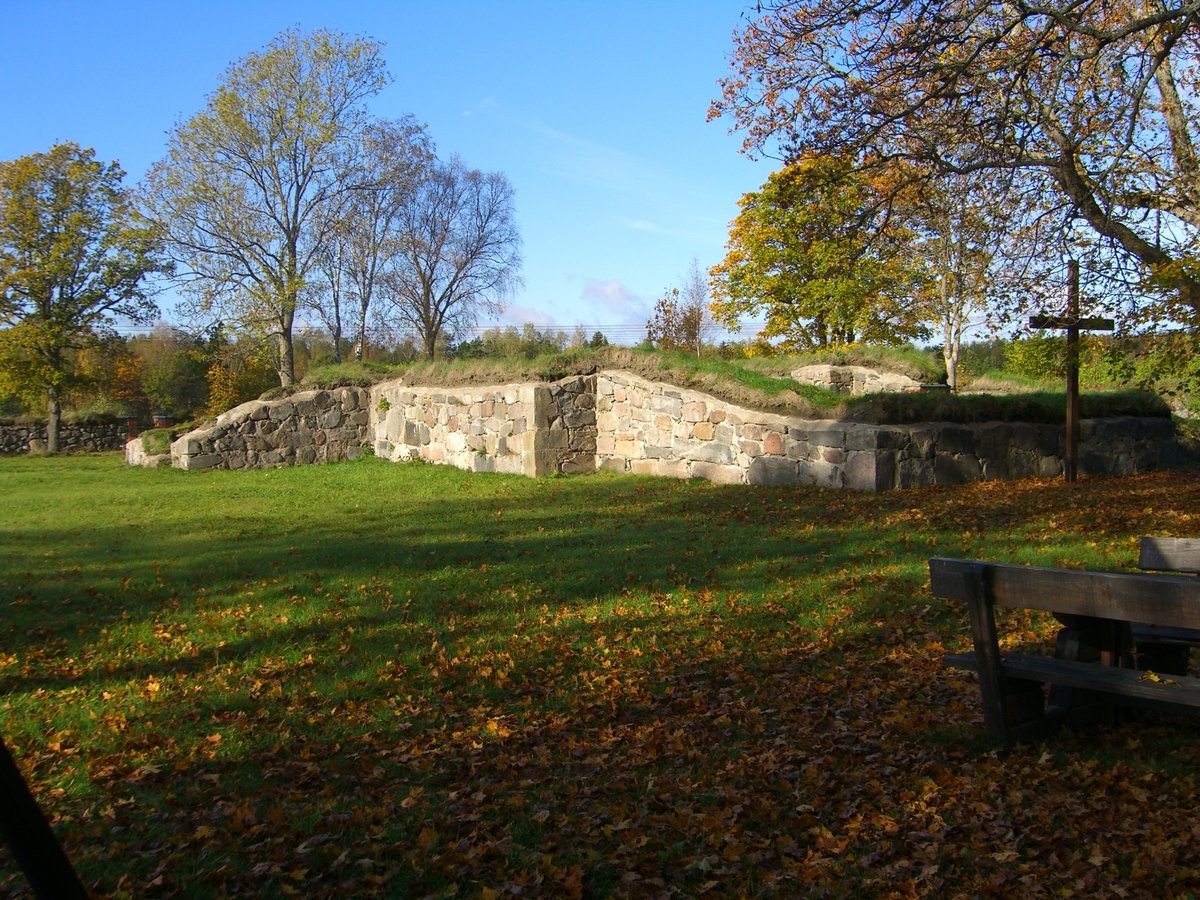

A hundred years and some to spare to build a church. But two centuries was all it took for Karls kyrkoruin to be abandoned to the elements, and for the community of Söderby-Karl to move on.Now it stands unfinished, its tower far shorter than originally planned, but its story incomplete too.When the church was built in the late 1200s, it received the patronage of Södermanland’s regent. The ruler’s anonymous name gave himself the name Karl. This king Karl, or Sankt Karlung in Swedish, was a folk hero, and by the 1300s his name had spread across the land – and the name of Roslagen too.
In the church, you see the first stone cut with the suggestion of his power. But you also see something else: a plan that never fully came to fruition.The church was in a parish, but not its main church. On the road between Söderby-Karl, the town, and Estuna, the primary church, the ruins of Karls kyrkoruin dedicated themselves to their saint, but they never managed to serve their people. The carved dragons who watched over them never finished being carved.
The towers never got their tops. And the walls never managed to keep the wind out after the people left. The story of the church is the story of the saint it was dedicated to – and the story of the people he failed to serve.After being abandoned, the church became a place to visit for those who sought to understand the saint. Pilgrims came from far and wide to see where the legend was made and born, to see where the dragon heads carved into the pillars kept watch, where the sagas were sung and heard, or shared.
But all that is left now is the foundation, and the stories that live on – in the as-told-by-me version, or in the original tale.Over the years, there has been much speculation as to what is left of the remains of the church. Once, the ruins were said to be where Saint Karlung was buried, and a chapel was built as a relic for the memory of the man. But the chapel – and the story – eventually gave way to the wind and the elements, and left no trace.
However, there is evidence – in bones from other churches that bear witness to the passing of time, in the stones that stand, still standing tall, and in the stories that have been passed down.
Sources: Wikipedia, OpenStreetMap, Wikidata, Wikimedia Commons
Written by Nik Frost
Discuss this with the author and others
No comments yet. Be the first to start the conversation.