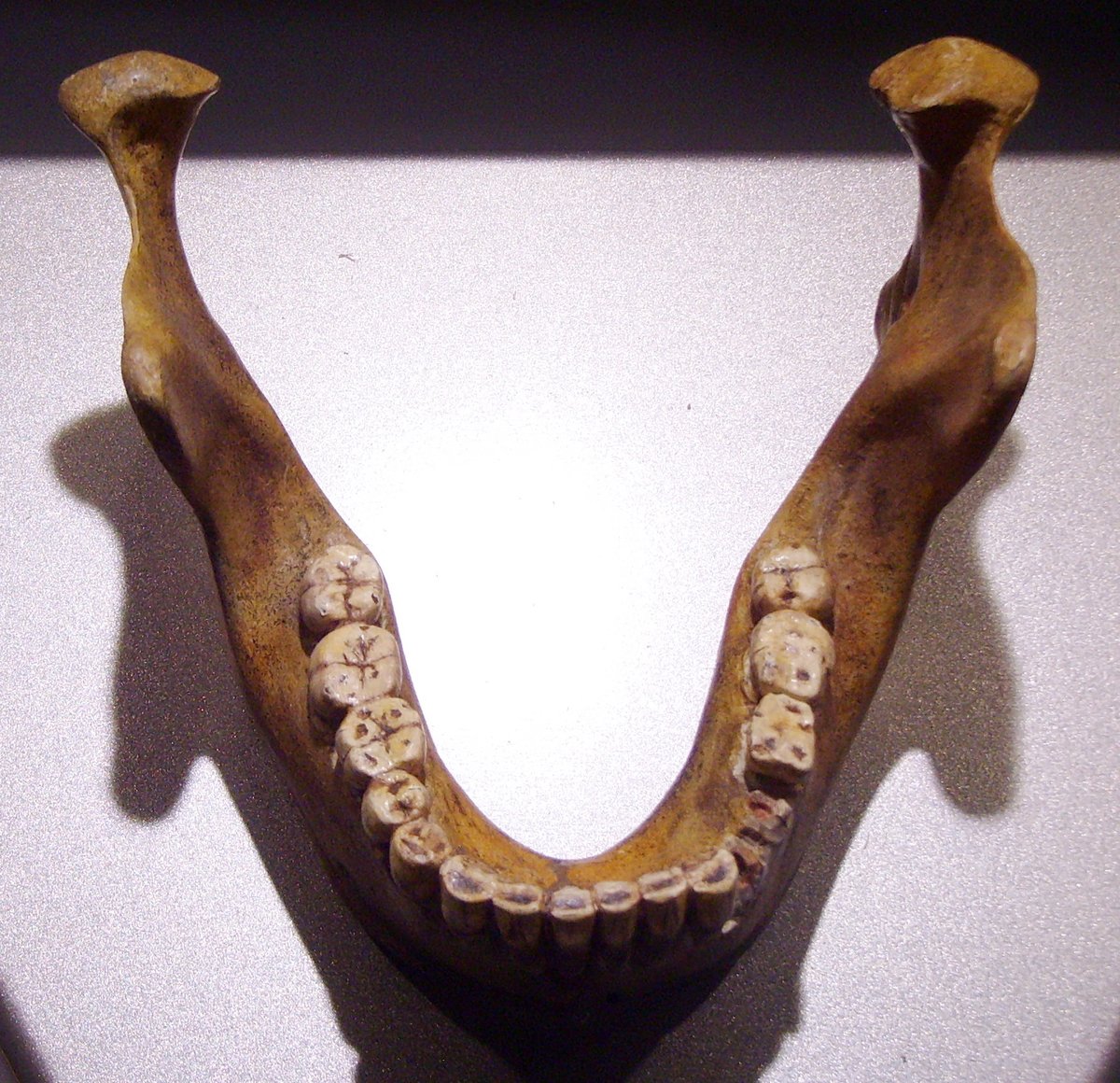
Daniel Hartmann was doing his job in a sand quarry near Mauer when he found a mandible at a depth of 24.63 m (80.81 ft). He recognized the bone as being of human origin and said he found 'Adam'. The find was the result of twenty years of searching by the Heidelberg scholar Otto Schoetensack, who had asked mine workers to look for fossils in the area for two decades.
Before this discovery, the mine had yielded a well-preserved skull of a straight-tusked elephant in 1887. Schoetensack visited the site regularly, teaching workers to identify human bones based on recent examples. On October 21, 1907, the workers found the mandible, which was flung into the air during excavation and broke into two parts. A piece of the left side of the mandible broke off and was never found.
The mandible lacked an outer projection of the chin portion, and the mandibular body had extremely strange dimensions. Scholars noted a certain disproportion between the jaw and the teeth, stating the teeth are too small for the bone. The lower jaw was large enough to have had space to develop a fourth premolar behind the wisdom tooth, and the third molar had exposed dentin in a few places. It became the type specimen for the species Homo heidelbergensis.
The jaw revealed a thick cemented crust of coarse sand on the canines and molars caused by carbonation of calcium. Stuck to this crust on the left side was a 6 cm (2.4 in) long and 4 cm (1.6 in) wide chunk of limestone, probably Muschelkalk. While early literature cited ages of either 600,000 or 500,000 years, the age of the mandible was determined in 2010 to be 609,000 ± 40,000 years.
Today, the mandible remains in the Geological-Palaeontological Institute at the University of Heidelberg, described as the most valuable object in the university's natural history collections. The part of the mine where the jaw came to light was filled with overburden in the 1930s. The site was later re-natured as arable land and declared a nature reserve in 1982.
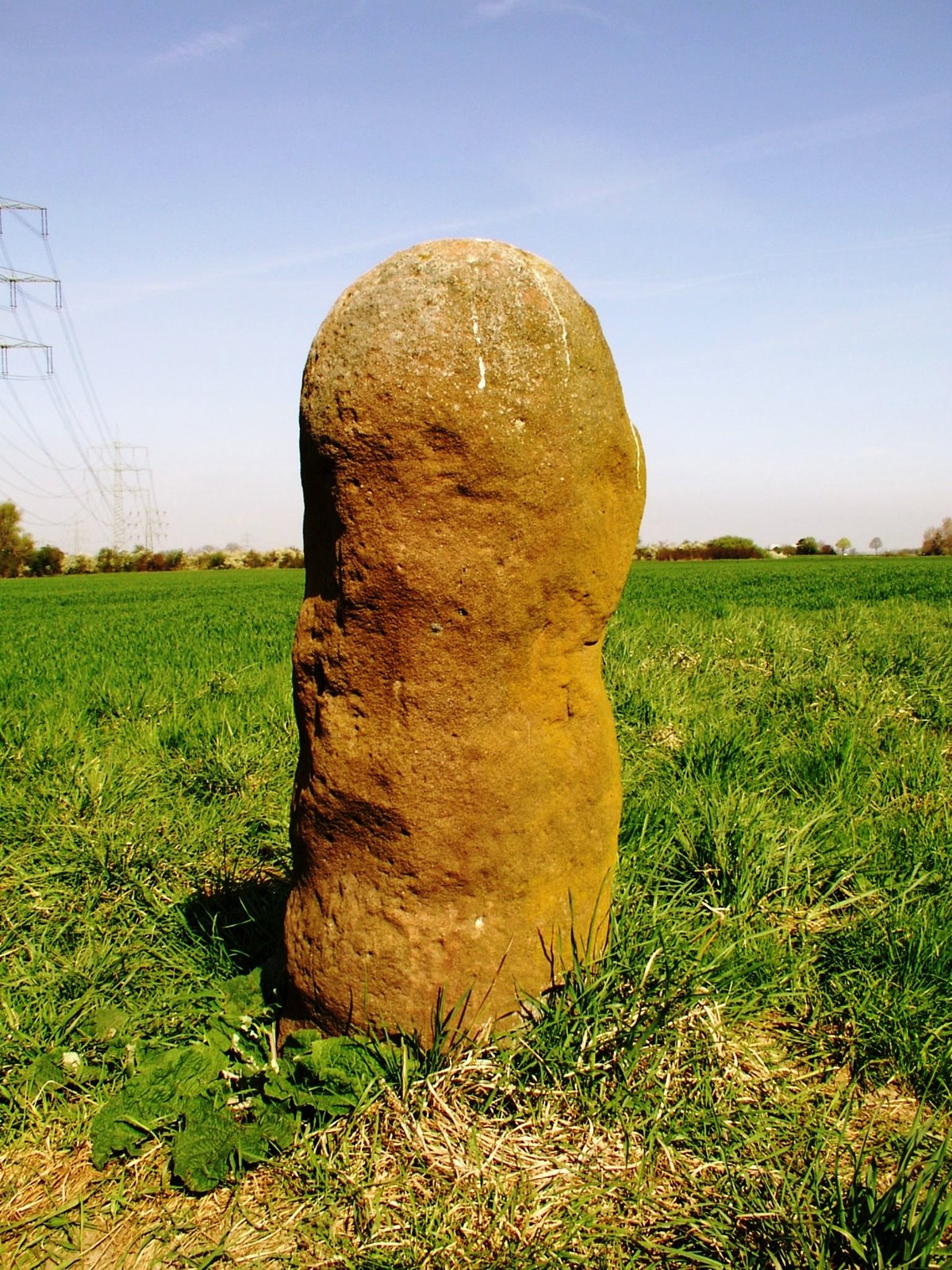
In the center of the site, a commemorative stone stands to mark the level of the find. It features a horizontal line representing the level where the mandible was unearthed. This marker remains at the location where the oldest known specimen of the genus Homo in Germany was discovered.
Sources: Wikipedia, OpenStreetMap, Wikidata, Wikimedia Commons


Written by Aurora
Discuss this with the author and others
No comments yet. Be the first to start the conversation.