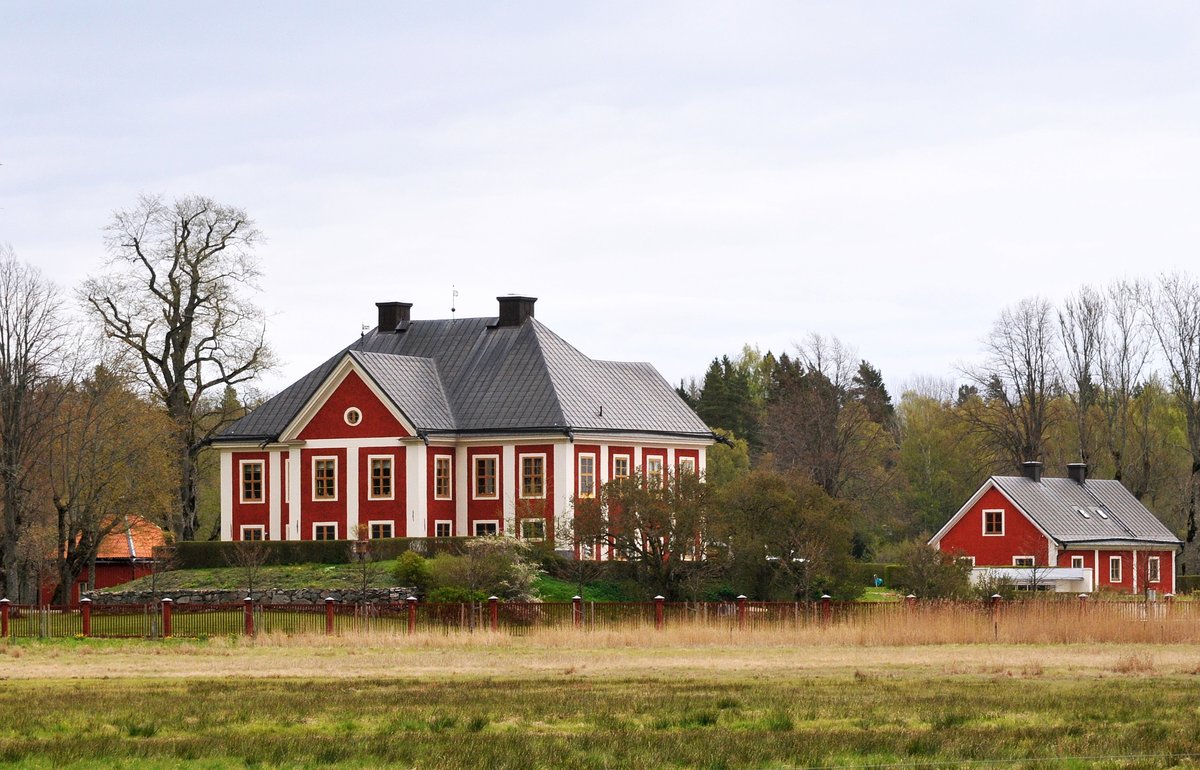

Hånö is an island manor in Bälinge township in Nyköping county in Södermanland. Its growth came more from the subtle trades and shrewd maneuvers of its owners than from the fine intentions they may have had. With all its cunning, though, Hånö emerged over centuries as more than just an island estate or a country seat. When the sun sets on a summer evening, it does so over a sprawling combination of fields, farm buildings, and forgotten footpaths, a patchwork that hints at the flashpoints and the forces that shaped Hånö. However, there is a contradiction in the timeline of events: Henri Fleming is said to have commissioned a new building in the 1640s, but the building is said to have been completed by 1685. Please verify this detail.
Hånö owes its name to its landscape: a promontory in the lake, where the Swedes settled. It was mentioned as säteri, or manor, in 1611, born of two neighbouring farms – Koppardal and Svinesund. Both farms are mentioned on the 1300s, when they belonged to a local lord, Nynäs slott. Koppardal, Svinesund, the farm of Sjö and two more in Berg formed the Hånöhalvön, under Länsherren, Tärnö at the time. Three of the farms belonged to Margareta Birgersdotter (Grip). When she died around the turn of 16th and 17th century, her husband Sten Axelsson Banér inherited these farms, but not for long. His lands were confiscated by the king, only to be returned to the Grip family a few years later. They sold them on, and the farms on Hånöhalvön passed to Karin Joensdotter on Sjösa säteri.
Karin Joensdotter was close kin to Sigrid Kurtzel, who inherited these farms after her death. Sigrid married Nils Ryning, but he died young, and she remarried with Henrik Fleming in 1633. It was Henrik Fleming who took practical steps to upgrade her farms. The old buildings might not have been grand, but they suits the new owner, a politician who needed to present an air of power more than an air of wealth.
Henrik Fleming commissioned a new building in the 1640s. It was protected from the winds and high tides by its position on the lake and the island, and the building's stone blocks was quarried nearby. The new building was a statement that turning these farms into a säteri, a manor, was no mere ambition but a reality. As a manor, it came with privileges. Once complete, it was eligible for a higher tariff rate on its crops and could count more men for military service.
Sigrid Kurtzel, who continued to live on Hånö, died in 1658. Her son, Jakob Fleming, inherited the estate. Jakob was no stranger to land and power – he had inherited Holbonäs säteri and came to own Ökna and Flemingshov, as well as the farms of Harlinge and Yxtaholm. He expanded Hånö with a series of deals and shrewd moves, until it included Sundet, Bodsnäset, and Bodsängen – a large plum reached by a deal with Konrad Gyllenstierna on Nynäs. He also commissioned new wing buildings, though they might not have been complete by 1685.
Sources: Wikipedia, OpenStreetMap, Wikidata, Wikimedia Commons
Written by Nik Frost
Discuss this with the author and others
No comments yet. Be the first to start the conversation.