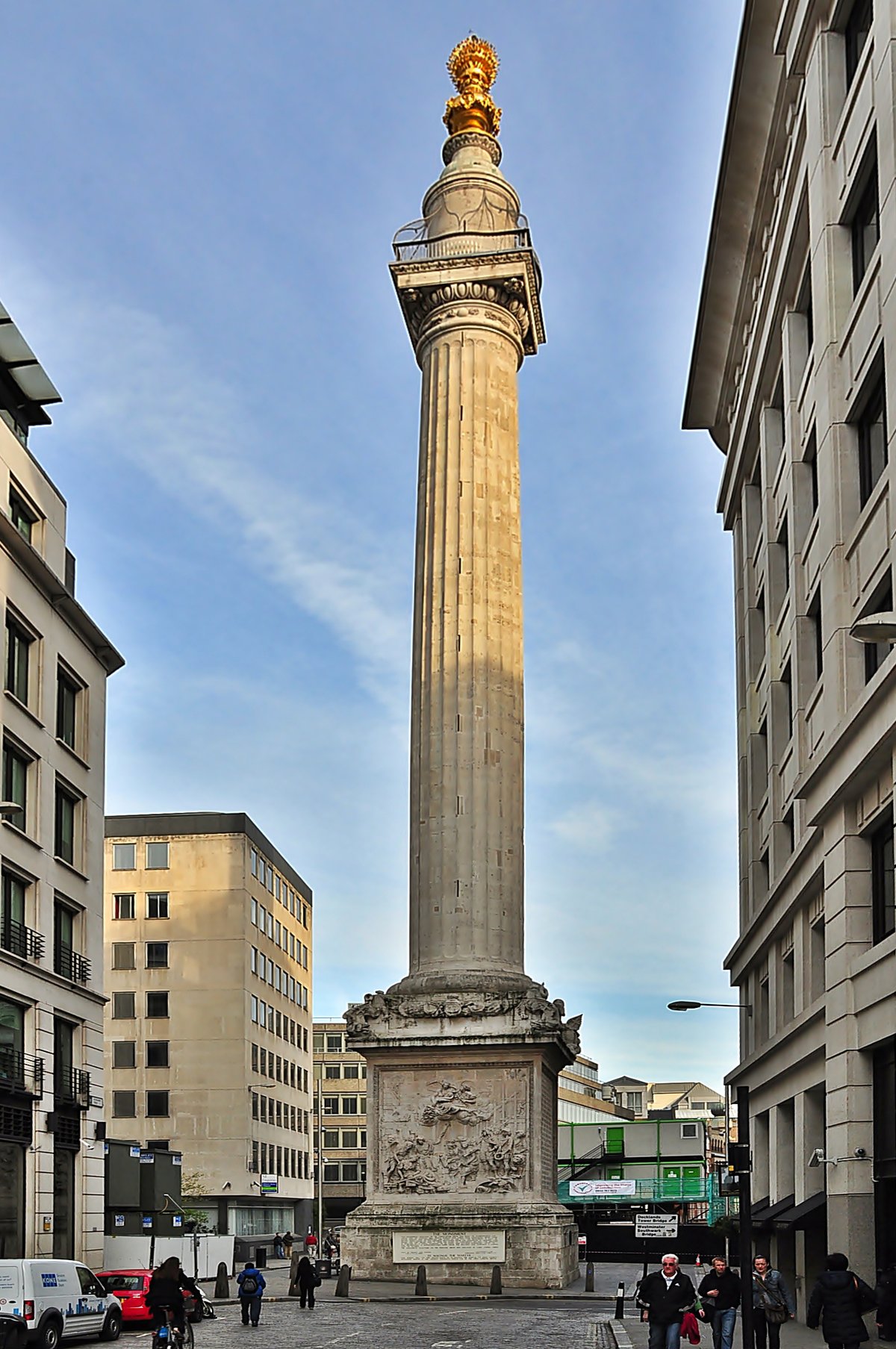

London's towering Monument, a 62-metre-tall Doric column, was constructed between 1671 and 1677 as a mark of respect for the Great Fire of 1666. It stands at the junction of Monument Street and Fish Street Hill, its height marking its distance from the shop of Thomas Farriner, the king's baker, where the blaze began.
The structure was designed by Robert Hooke, who worked as an architect for Christopher Wren. While Wren was asked to submit a design, Hooke developed the plans for the fluted Doric column built of Portland stone. The City Council approved the design in 1671, and it took six years to complete the column. It was topped with a flaming gilt-bronze urn, a design suggested by Hooke after other options, such as a statue of a phoenix or the king, were rejected.
Beyond its role as a memorial, Wren and Hooke designed the monument to double as a scientific instrument. It features a central shaft intended for use as a zenith telescope and for experiments in gravity and pendulums, connecting to an underground laboratory. Though traffic vibrations eventually made these experiments difficult, the monument remains a significant Grade I-listed site in the heart of London.
Sources: Wikipedia, OpenStreetMap, Wikidata, Wikimedia Commons


Written by Nicolo Ciampini
Discuss this with the author and others
No comments yet. Be the first to start the conversation.