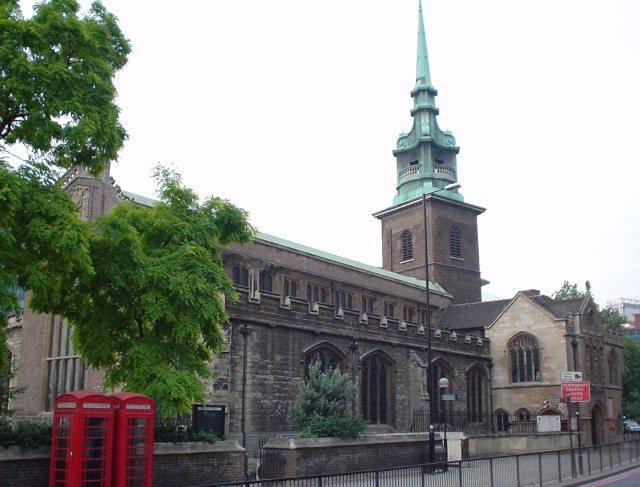

The church website claims All Hallows-by-the-Tower was founded in AD 675, although recent research has questioned these claims. Research suggests that while an original church could have been built as early as the 7th century, it is more likely that the stone church, of which an arch is a remnant, superseded an earlier wooden building. The arch itself was constructed using reused Roman tiles and stonework.
In 1086, the Domesday Book mentioned Barking Abbey - a Roman Catholic Benedictine nunnery - possessed "28 houses and half a church" in London. Although the church is not named, it is usually identified with All Hallows. During clearance after destruction caused by bombing in 1940, an archway built of reused Roman tiles and stonework was revealed in a surviving wall of the medieval church.
In 1650, barrels of gunpowder stored in an adjacent warehouse exploded, destroying the west tower and many nearby houses. The tower was rebuilt in 1658. The church also narrowly survived the Great Fire of London in 1666, thanks to Admiral William Penn, who had men from a nearby naval yard blow up surrounding buildings to create firebreaks. The church also served as a temporary burial place for beheaded victims of the Tower, including Sir Thomas More.
Today, the church features 15th-century outer walls and a Baptismal font cover carved in 1682 by Grinling Gibbons for £12. It remains the guild church of Toc H, the international Christian organisation founded by Tubby Clayton, who served as vicar from 1922 until 1962.
Sources: Wikipedia, OpenStreetMap, Wikidata, Wikimedia Commons


Written by Nicolo Ciampini
Discuss this with the author and others
No comments yet. Be the first to start the conversation.