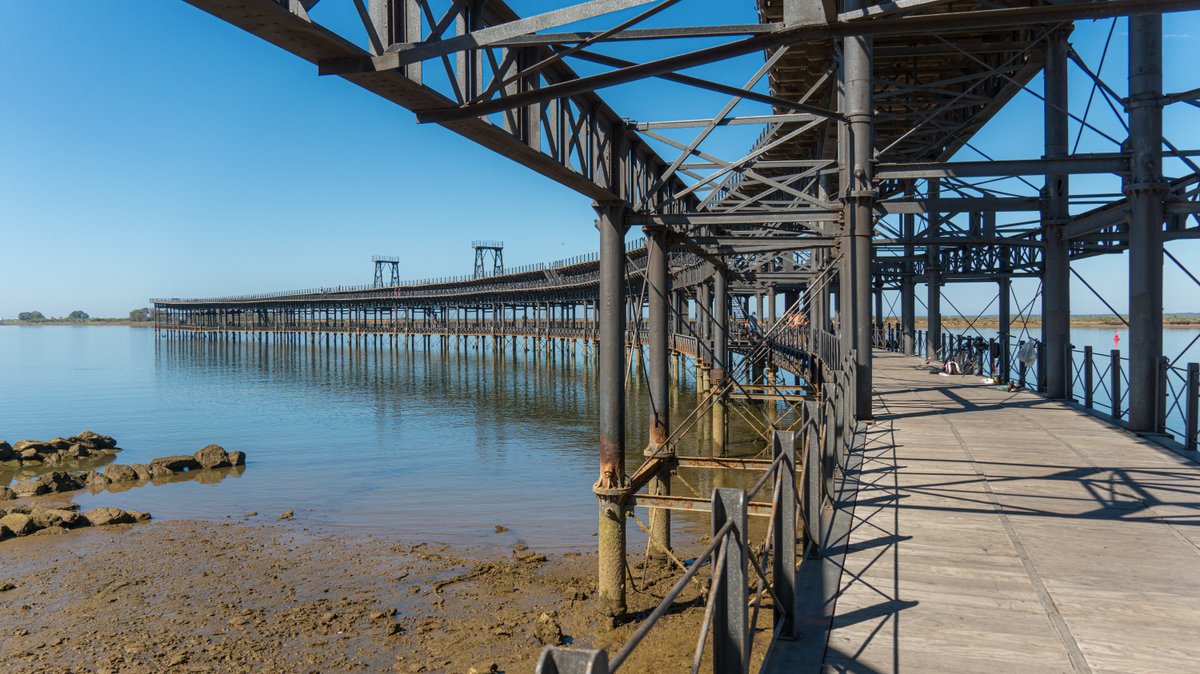

Located in the heart of Huelva, in Spain, the Rio Tinto Pier is more than just a simple dock.Built between 1874 and 1876, it is a testament to the rich history of Spain's copper industry and a symbol of the town's transformation from a small fishing village to a bustling hub.Designed by Sir George Barclay Bruce and Thomas Gibson, the Pier stretches for 1165 meters along the River Odiel. Its unique foundation is on wooden platforms at the bottom of the estuary, a feature that sets it apart from other piers of its time.
The Pier was built to transport ore from the mines to ships, using gravity rather than mechanical systems.Originally mining activities along the Rio Tinto site date back to 3000 BCE. The Spanish government began mining again in 1724, but operations were inefficient. The mine was bought by Matheson and Company in 1873 and the Rio Tinto Company was launched. The Rothschild family later gained control of the Rio Tinto Company. An 83-mile railway was built between 1875 and 1876 to transport the ore.
The mine had a significant impact on Huelva, transforming it from a small fishing village. Construction of the pier was also a key part of the expansion of the Rio Tinto Company. The pier remained in service until May 1975 and ships began to use a new facility in the nearby port of Huelva in May 1975. The Pier's foundation, which is on wooden platforms at the bottom of the estuary, was initially 238-meter long. For the next 225 meters, it is on a wooden viaduct. Double rows of four cast iron pillars support the rest of the pier (60 rows of four pillars). In total, this iron section was 577.6 meters long. About 50 meters of the pier were destroyed in 1974 to make way for road widening.
Sources: Wikipedia, OpenStreetMap, Wikidata, Wikimedia Commons
Written by Nik Frost
Discuss this with the author and others
No comments yet. Be the first to start the conversation.