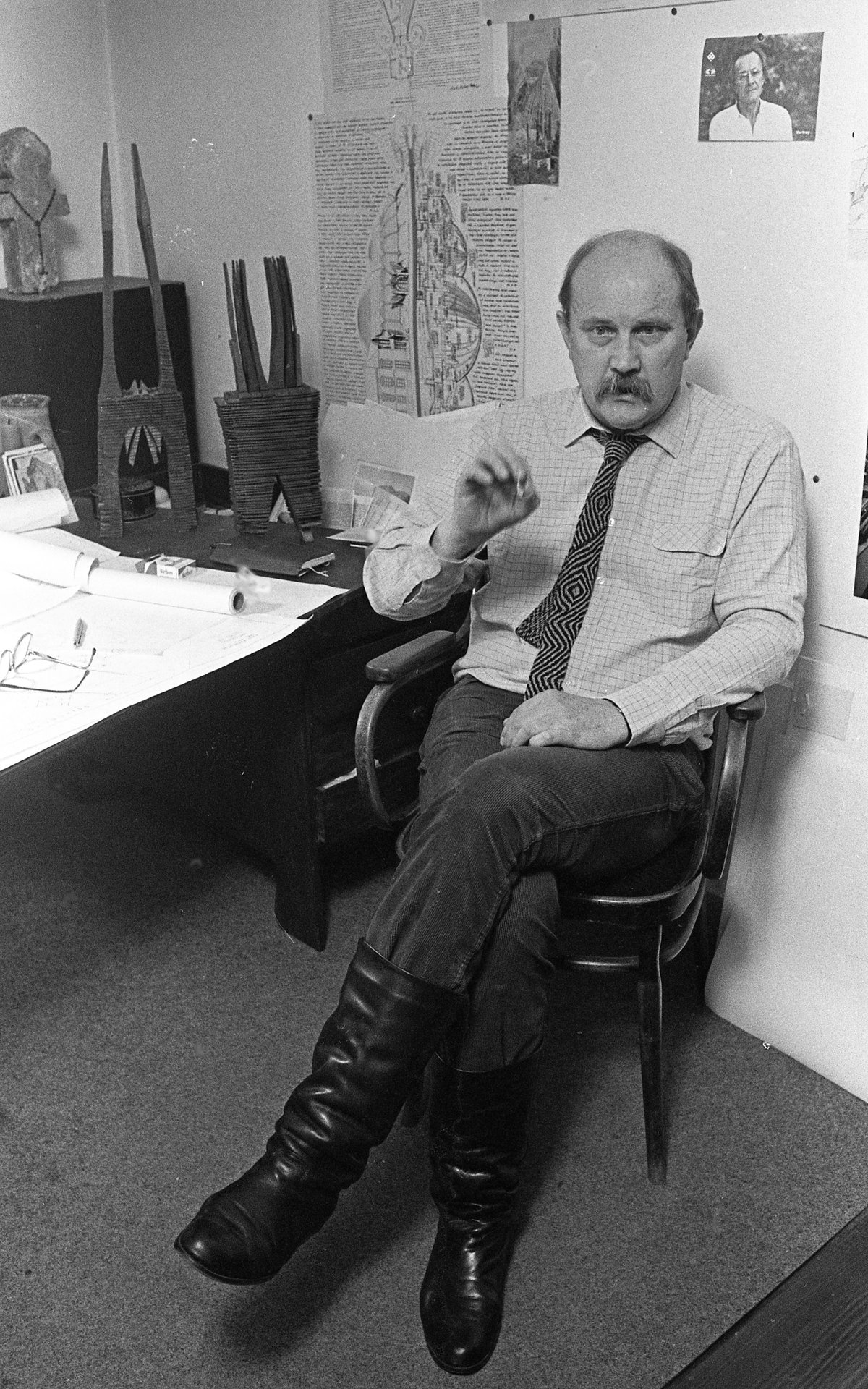

The Hungarian pavilion at Expo '92 in Sevilla, Spain, was a unique work of Hungarian architect Imre Makovecz, heavily influenced by his organic architecture style. Born and raised in Budapest, he attended the Technical University of Budapest and later became the founder and eternal and executive president of the Hungarian Academy of Arts. He was recognized with the Ybl Prize and the Kossuth Prize, both revered awards in Hungary. Makovecz was also a devout Catholic, and his work was a response to the communist ideology, later becoming a commentary on globalization and the corporatization of culture.
A monograph on Makovecz’s work, Imre Makovecz: The Wings of the Soul, was published in 1997. Recently, his work has been examined in a broader context to understand its place in Hungarian culture. When Expo '92 was announced, Makovecz was selected to design the Hungarian pavilion. Drawing on traditional Hungarian art, Woodland magic, and organic architecture, he created a treehouse-like structure that connected with the surrounding environment rather than dominating it, much like a treehouse among trees. Today, it still stands on Calle Marie Curie in Sevilla, a unique piece of architectural history.
Makovecz worked in Europe from the late 1950s onward. He was a proponent of organic architecture, drawing inspiration from Frank Lloyd Wright and Rudolf Steiner. His work was a critique of communist ideology and later became a commentary on globalization and corporate culture.
In 1992, Makovecz designed the Hungarian pavilion for the Expo in Seville, Spain. The pavilion was meant to represent Hungary and its culture, and Makovecz infused it with his organic design philosophy. The pavilion was shaped like a treehouse, with branches reaching out into the sky. Inside, it was filled with wooden sculptures and carvings that represented various aspects of Hungarian culture.
Sources: Wikipedia, OpenStreetMap, Wikidata, Wikimedia Commons
Written by Nicolo Ciampini
Discuss this with the author and others
No comments yet. Be the first to start the conversation.