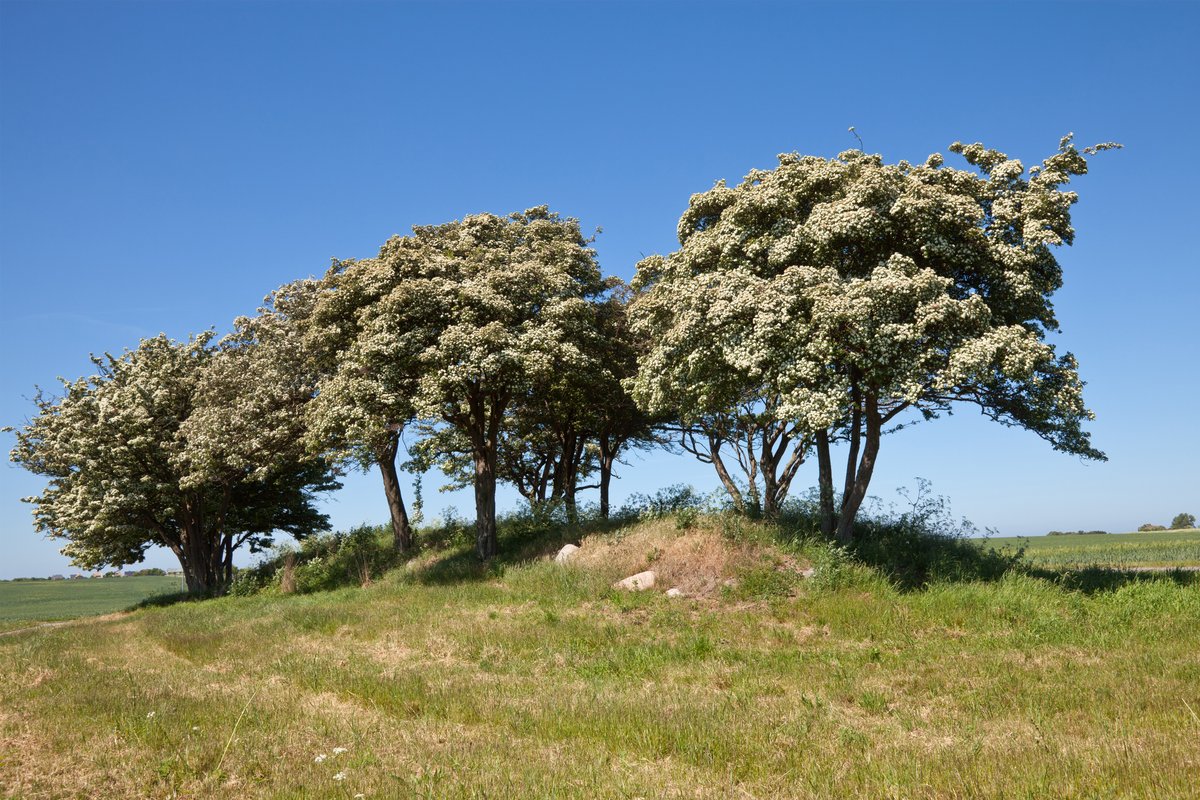
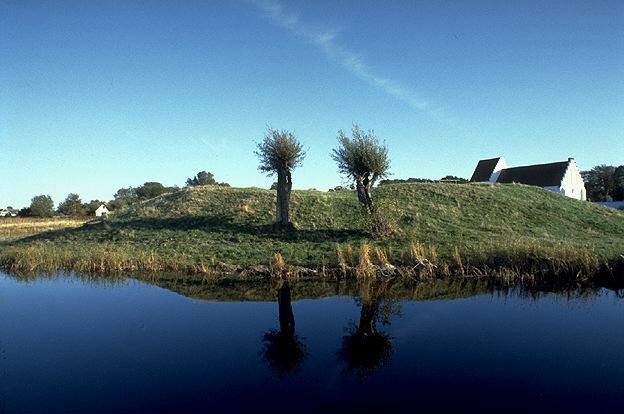
A solitary mound of stone sits in a wedge between the road to the west and the path toward Starrvitz. It is a quiet, heavy presence on the island of Rügen, a trapezoidal burial chamber lying nearly 40 metres long and 12 metres wide. This is the Großsteingrab Starrvitz, the lone survivor of a prehistoric neighborhood that was once much more crowded.
In the Neolithic era, the Funnelbeaker culture moved these massive stones to create a collective resting place. They built four megalithic tomb complexes in the area near Gramtitz, carving a permanent mark into the landscape for the dead. Today, only this one remains. The other three graves, which once clustered less than 1.2 kilometres to the east near the road to Mattchow, were destroyed during the 19th century. They were intended to be companions, but time and human intervention simplified the map until only one stayed behind.
The archaeological record captures this shrinking history in stages. Friedrich von Hagenow walked these fields in the 1820s, documenting the existence of the graves and marking them on the 1829 Special Charte of Rügen. Even then, the map already indicated that the three eastern graves were gone. It took nearly a century for his handwritten notes to be published by Rudolf Baier in 1904, providing a list of the site's remnants. Later, in 1931, Ernst Sprockhoff formally documented the surviving western grave for his atlas, naming it by its location in Starrvitz.
The structure itself holds specific secrets of Neolithic engineering. While the mound stands just 2 metres high, the burial chamber is oriented roughly east-west. Along its long sides, numerous enclosure stones are still preserved, anchoring the mound to the earth. In the western section, a single stone protrudes - a fragment of a chamber that is now almost completely covered by soil. Experts like Ewald Schuldt and Hans-Jürgen Beier identify the chamber as a Großdolmen, a form common across the island, though the internal shape of the hidden chamber remains a mystery.
Visitors today find a site that feels like a footnote to a larger, lost chapter. You can see the lingering geometry of the trapezoid and the way the stones lean into the grass. It is a study in endurance, the only piece of a four-part puzzle left standing against the erasure of the 1800s. The others are ghosts in the archives, but the Starrvitz grave remains a physical weight in the dirt of Gramtitz.
Sources: Wikipedia, OpenStreetMap, Wikidata, Wikimedia Commons
Written by Aurora
Discuss this with the author and others
No comments yet. Be the first to start the conversation.