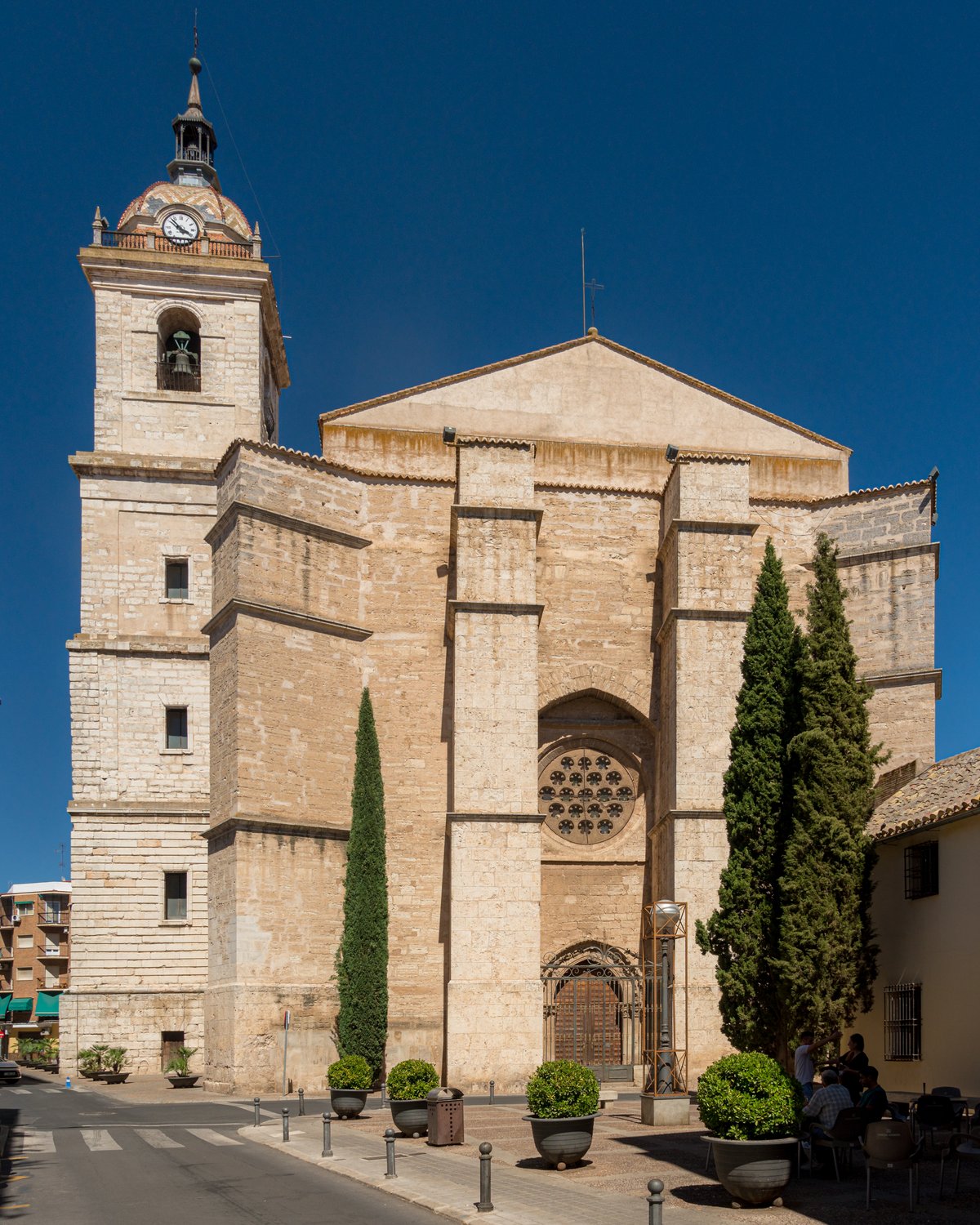

The **Cathedral of Saint Mary of the Prado** has been a part of Ciudad Real, autonomous region of [Castile-La Mancha](https://en.wikipedia.org/wiki/Castile-La_Mancha), Spain, for seven centuries. Construction began in the 15th century, its building style a blend of Gothic and Romanesque architectural elements, with additional touches of Renaissance and Baroque influences. The oldest part of the cathedral, the **Door of Forgiveness (Puerta del Perdón)**, dates to the late 13th or early 14th century.
The **apse** was built in the early 15th century, and the **eastern section of the nave** was completed in 1514. The current structure, which consists principally of a gigantic nave stands 34 meters (112 feet) high, 53 meters (174 feet) long, and 18 meters (59 feet) wide, making it the second largest in Spain only to the [Girona Cathedral](https://en.wikipedia.org/wiki/Girona_Cathedral). This grandiose design is testament to the Middle Ages and the Renaissance, capturing the spirit of the era.
Since 1875, it has been the priory of the [Order of Calatrava](https://en.wikipedia.org/wiki/Order_of_Calatrava). The magnificent **Baroque altarpiece** is the work of [Giraldo de Merlo](https://en.wikipedia.org/wiki/Giraldo_de_Merlo) and his son-in-law, the painter [Juan de Hasten](https://en.wikipedia.org/wiki/Juan_de_Hasten). The work was continued by the brothers [Cristóbal](https://es.wikipedia.org/wiki/Crist%C3%B3bal_Ruiz_Delvira) and [Pedro Ruiz Delvira](https://es.wikipedia.org/wiki/Pedro_Ruiz_Delvira) who entrusted [Juan de Villaseca](https://es.wikipedia.org/wiki/Juan_de_Villaseca) to implement a design created by [Andrés de la Concha](https://es.wikipedia.org/wiki/Andr%C3%A9s_de_la_Concha) and completed in 1616.
The altarpiece is dedicated to the [Virgen de la Prado](https://es.wikipedia.org/wiki/Virgen_de_la_Prado), the patron saint of Ciudad Real. The intricate carved walnut pews are from the first half of the 19th century.
Sources: Wikipedia, OpenStreetMap, Wikidata, Wikimedia Commons
Written by Nik Frost
Discuss this with the author and others
No comments yet. Be the first to start the conversation.