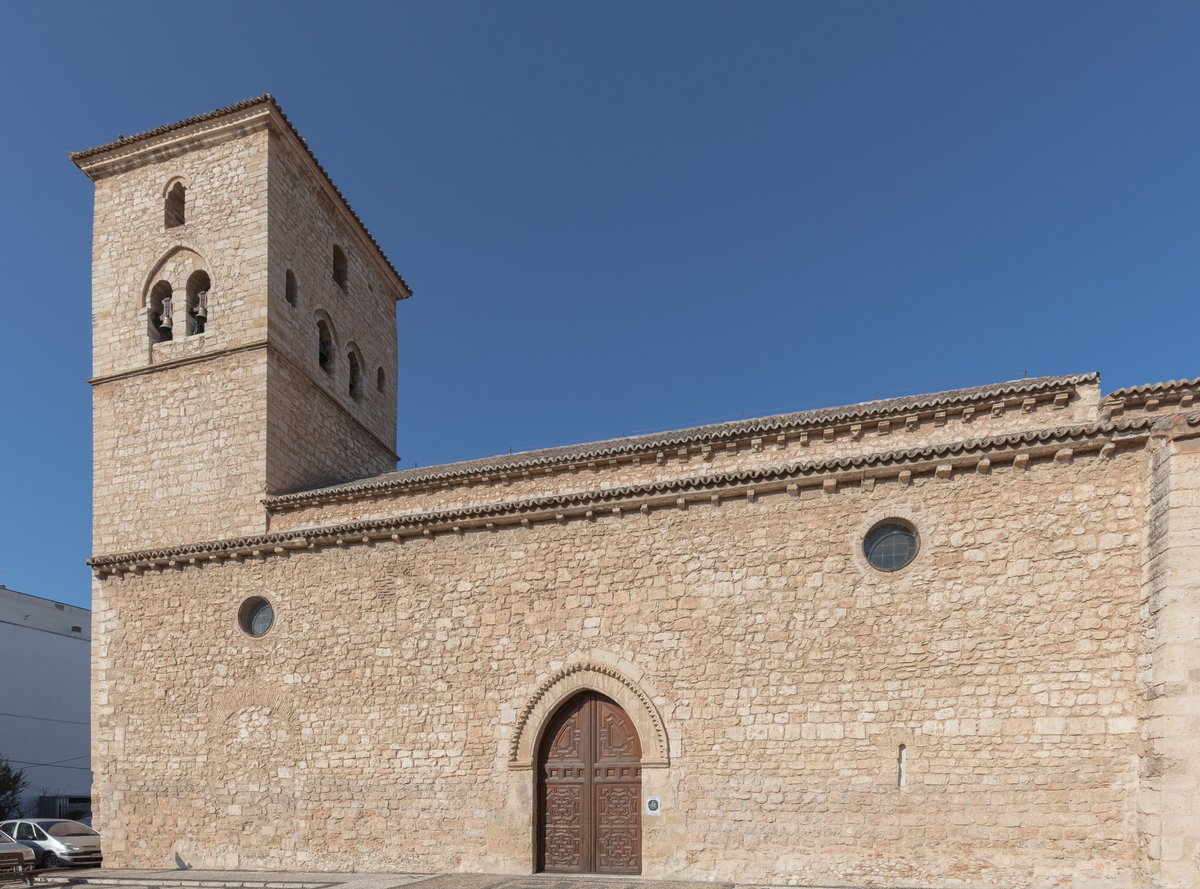

The Church of Santiago Apostle, located in Ciudad Real, Spain, showcases a mix of Romanesque and Gothic architecture, constructed at the end of the 13th century and the beginning of the 14th century. Its exterior suggest a Romanesque style, but its interior and tower, possibly built in the early 13th century post-Alarcos, exhibit evidence of Islamic influences. This church was one of the three parishes that formed the city, situated northeast of the city between the streets Toledo and Calatrava.
The central Gothic vault of the church houses a fresco with eight dragons, while a 16th-century shield of the Order of Santiago adorns a lateral chapel. The interior nave showcases a Mudéjar ceiling from the 14th century decorated with intricate lacework, octagonal stars with lobed flowers made with silver foil, and thirty-two colored wooden canes adorned with heraldic shields and figurative human-shaped objects.
The crucifix on the ceiling was originally black until the 15th century, but the one found on this ceiling is red.
The Church of Santiago in Ciudad Real underwent restoration from 1985-1989 by the Consejería de Educación y Cultura de la JCCM. During the restoration, mudéjar artesonado was discovered hidden under a 18th-century barrel-vaulted ceiling, and the structure of the tower was consolidated. A contemporary brick covertize was demolished from the portada, and painted murals were found when the walls were cleaned and a layer of yeso was removed.
Sources: Wikipedia, OpenStreetMap, Wikidata, Wikimedia Commons
Written by Nik Frost
Discuss this with the author and others
No comments yet. Be the first to start the conversation.