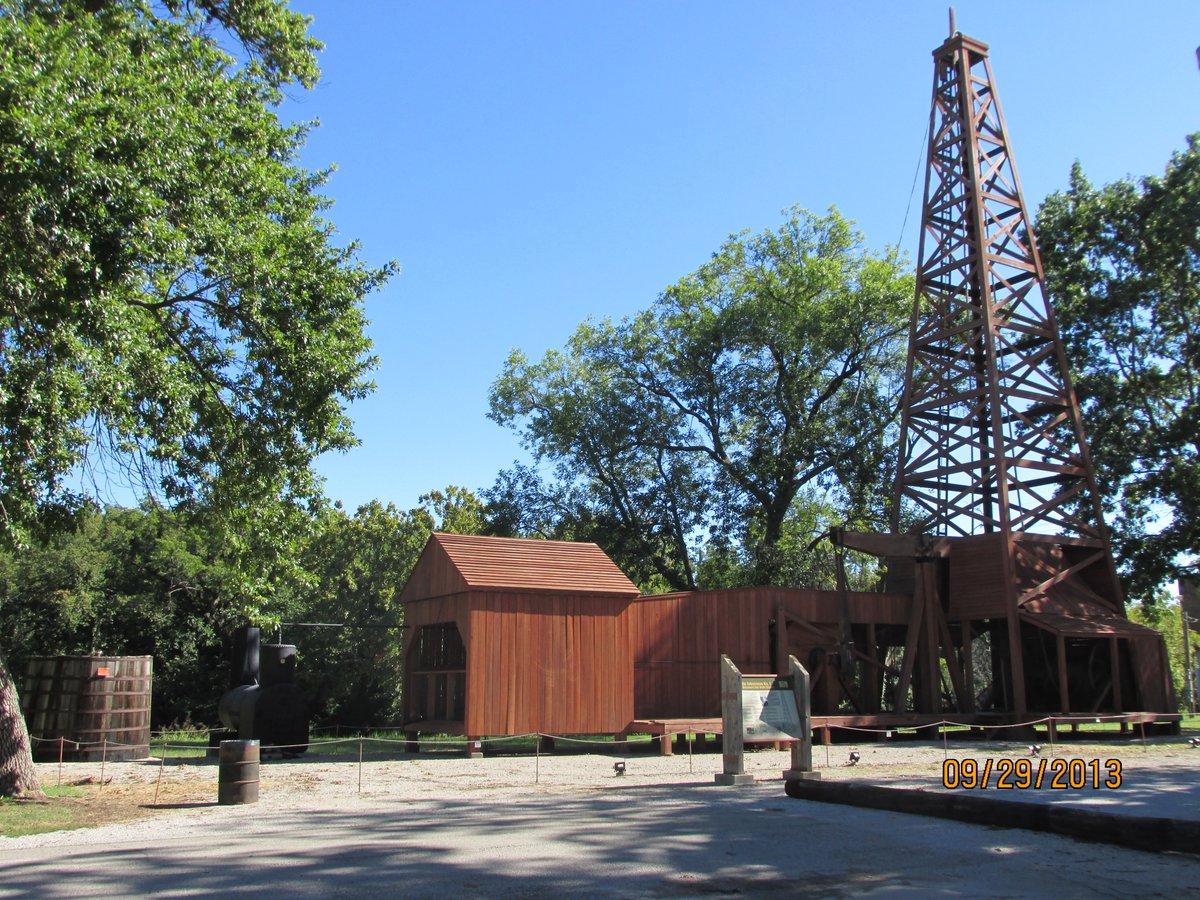
Drilling for the Nellie Johnstone No. 1 well commenced in January 1897 under the direction of the Johnstone-Keeler partnership, which had secured mineral leases on Cherokee Nation land along the Caney River near Bartlesville in Indian Territory. After abandoning a dry hole near Red Fork in December 1896, the operation utilized the cable-tool drilling method, a standard percussion technique of the era where a heavy bit attached to a cable was repeatedly dropped to chip away at the rock formation. This labor-intensive process was carried out by the experienced firm of McBride and Bloom from Independence, Kansas, known for drilling Kansas's first successful well; the crew included local partners George B. Keeler, William Johnstone, and Frank Overlees, along with an expert nitroglycerin 'shooter,' G.M. Perry.
Following its breakthrough on April 15, 1897, Nellie Johnstone No. 1 initially flowed at a rate of 50 to 75 barrels of oil per day, marking the start of commercial oil production in what would become Oklahoma. The success of Nellie Johnstone No. 1 ignited the Bartlesville oil boom in the late 1890s, marking the onset of commercial petroleum development in what would become Oklahoma and prompting widespread exploration across nearby Osage and Cherokee lands.
This discovery well, initially producing around 50 to 75 barrels per day after its 1900 reactivation, spurred the drilling of additional wells in the Bartlesville-Dewey field, transforming a modest trading post area into a bustling oil hub. By the early 1900s, the influx of wildcatters and leaseholders had established Bartlesville as the epicenter of the territory's nascent industry, with production ramping up to support regional refining and export.
As the discovery well for the vast Bartlesville-Dewey oil field, Nellie Johnstone No. 1 spurred widespread exploration across Indian Territory and Osage lands, propelling Oklahoma's annual oil output from 1,000 barrels in 1897 to over 43 million by 1907 and making the territory the nation's largest oil producer before statehood.
Sources: Wikipedia, OpenStreetMap, Wikidata, Wikimedia Commons
Written by Friendly Jane
Discuss this with the author and others
No comments yet. Be the first to start the conversation.