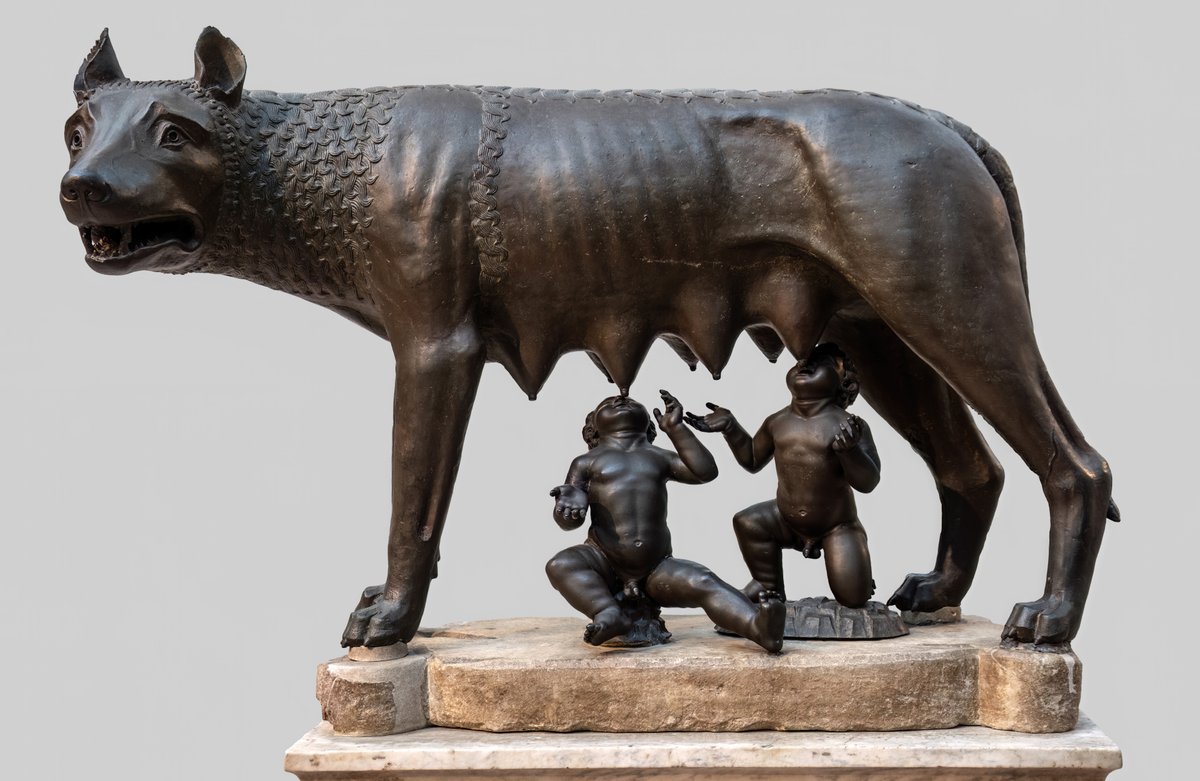

The Capitoline Wolf is a bronze sculpture depicting the legendary founding of Rome, showing a she-wolf suckling the mythical twins Romulus and Remus. For centuries, the statue was widely assumed to be an Etruscan work from the fifth century BC, with the twins added later in the late 15th century. This traditional dating was supported by scholars who believed the damage to the wolf's paw corresponded to a lightning strike in 65 BC. However, modern analysis has called this history into question.
The sculpture's construction provides significant clues to its true age. In 1997, art historian Anna Maria Carruba observed that the wolf was cast in a single piece using a variation of the lost-wax technique. This method was common in the Middle Ages for casting rigid items like bells and cannons, but was not used for large sculptures in Classical antiquity. Furthermore, archaeologist Adriano La Regina argued that the artistic style is more akin to Carolingian and Romanesque art than to the ancient world, while others suggested the paw damage resulted from an error during the moulding process.
Recent scientific testing has provided further evidence for a medieval origin. Radiocarbon dating of organic residues in the casting cores in 2007 suggested the wolf was made between 1021 and 1153 AD, while thermoluminescence dating in 2021 constrained the creation to between the 8th and 14th centuries. Additionally, a 2025 lead isotope analysis suggests the bronze's metallic composition is consistent with copper from mines in the Holy Roman Empire. While these results have been contested, they continue to challenge the consensus on the sculpture's ancient origins.
Sources: Wikipedia, OpenStreetMap, Wikidata, Wikimedia Commons

Written by Nicolo Ciampini
Discuss this with the author and others
No comments yet. Be the first to start the conversation.