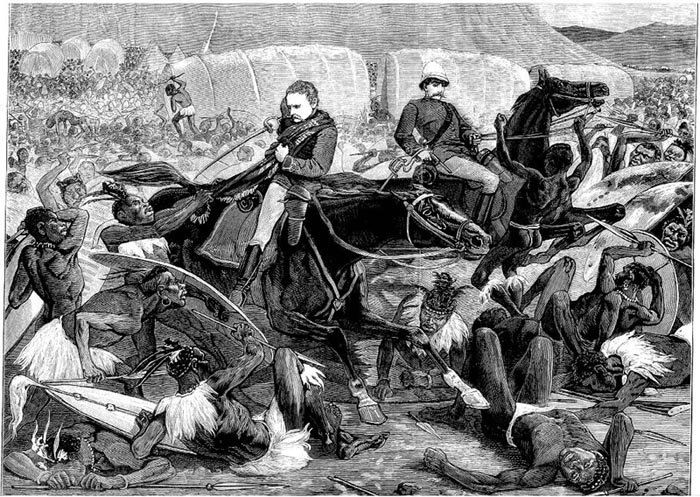

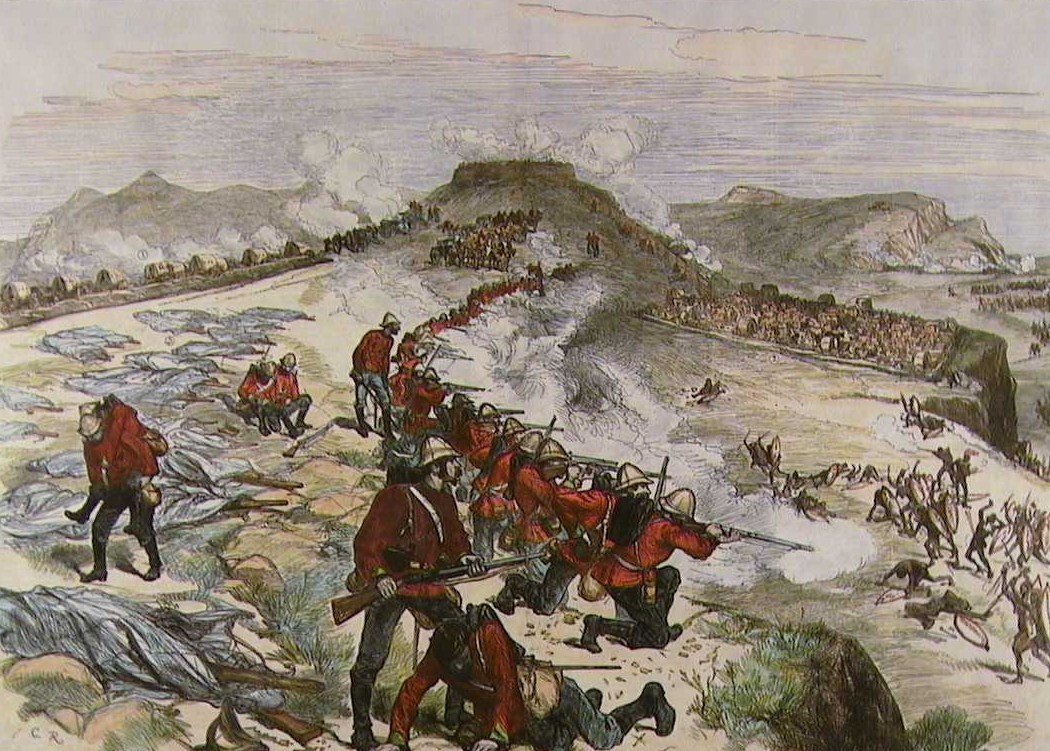
On 22 January 1879, the Battle of Isandlwana took place as the second major encounter in the Anglo-Zulu War between the British Empire and the Zulu Kingdom. A Zulu force of some 20,000 warriors attacked a portion of the British main column consisting of approximately 1,800 British, colonial and native troops with approximately 350 civilians. The Zulus were equipped mainly with traditional assegai iron spears and cow-hide shields, but also had a number of muskets and antiquated rifles.
The British and colonial troops were armed with the modern Martini–Henry breechloading rifle, two 7-pounder mountain guns, and a Hale rocket battery. Despite a vast advantage in weapons technology, the Zulus greatly outnumbered the British and ultimately overwhelmed them, killing over 1,300 troops, including all those out on the forward firing line. The British were unprepared for the attack from the large Zulu contingent, which moved quickly and attacked the flanks using the 'horns and chest of the buffalo' formation. The Zulu army suffered between 1,000 and 3,000 killed.
The victory for the Zulus caused the defeat of the first British invasion of Zululand and resulted in the British taking a much more aggressive approach in the war. Lord Chelmsford, the Commander-in-Chief of British forces, moved his troops from Pietermaritzburg to Rorke's Drift before commencing the crossing of the Buffalo River into Zululand on 11 January. The defeat at Isandlwana led to the destruction of King Cetshwayo's hopes of a negotiated peace and prompted a heavily reinforced second invasion.
Sources: Wikipedia, OpenStreetMap, Wikidata, Wikimedia Commons




Written by Mutabor
Discuss this with the author and others
No comments yet. Be the first to start the conversation.