


The Plaza building was constructed 101 years ago in the very center of New York City. The thing is, the best American city doesn’t really have a center: you could consider Wall Street or Times Square as the center, even though these places are about an hour’s walk apart. Or, quite justifiably, you could consider the square where the Fifth Avenue—groaning under the weight of tourists and citizens suddenly seized by shopping frenzy—suddenly meets the quiet and somehow existing Central Park inside the metropolis.
The hotel was built by architect Henry Janeway Hardenbergh (to whom New York also owes the famous residential complex "The Dakota"). The path to success and fame for The Plaza was rather short than long. The construction cost $12.5 million—a sum unimaginable at that time. The hotel became one of the tallest buildings in Manhattan: its height was 76 meters, and there were very few skyscrapers around then, with one of the most famous—the "Flatiron" building—only 11 meters taller.
The building became one of the dominant landmarks of Midtown Manhattan—the majestic building was the first thing visible from Central Park. On the grand opening day, October 1, 1907, guests were given a royal gift—taxis, which had just appeared on New York streets that year, gave them free rides all day long.
One of the stories connected to the Plaza Hotel involves a strap. In 1956, this very strap unexpectedly slipped off Marilyn Monroe’s shoulder during a press conference that the 20th century’s leading blonde held in a specially rented room called the Terrace Room. By the time the event ended, the strap had broken two more times. Camera shutters clicked nonstop—every photographer dreamed of capturing the embarrassed star. According to Monroe’s friend Eva Arnold and costume designer John Moore, Monroe had planned the strap trick in advance, attracting extra attention to a film that hadn’t yet been released.

As a producer, she was interested in a good box office. Be that as it may, this was just the beginning of her personal hell related to working with Olivier. For Marilyn Monroe, it was a difficult period in life that never ended: she wanted to appear more serious, even said she dreamed of playing in "The Brothers Karamazov," and was not at all embarrassed when asked whom exactly. "Grushenka," Marilyn Monroe said.
Then the strap just betrayed her and slipped off the actress’s shoulder. Some saw this as a grim omen, as if fate could not be escaped. Others, on the contrary, noticed that the strap slipped off at the most appropriate moment and, as it seemed to some, not at all unexpectedly. One way or another, this story was neither the first nor the last in the legendary history of the Plaza Hotel in New York.
Initially, the richest Americans settled in The Plaza, using hotel rooms more like luxurious apartments than temporary shelters; only the chosen few could afford this—the room cost no less than two and a half dollars per night. Among others, Alfred Gwynne Vanderbilt, one of the most prominent bearers of the famous surname, moved in with his wife. Soon, the Russian princess of German origin, Wilma Lvova-Parlay, settled there, along with her pet lion named Goldfleck. Keeping pets in hotels was prohibited, but The Plaza made an exception for Wilma. The story caused a big stir, even bigger than the portraits of prominent New Yorkers that the princess successfully began painting.
The calm luxurious life of The Plaza was momentarily disturbed in 1920. Then young writer F. Scott Fitzgerald shocked New York with his book "This Side of Paradise" and the logically ensuing sparkling, wild lifestyle funded by the royalties. Among other things, there were taxi roof rides with his young wife Zelda, and the highlight was swimming in the Pulitzer Fountain located right opposite the entrance to The Plaza, at the feet of the goddess of tree fruits Pomona who crowns the fountain.

The hotel still proudly recalls this remarkable incident. Even more, it prides itself on the fact that part of the action of "The Great Gatsby," written five years later, takes place right at The Plaza, where the decisive confrontation of the characters occurs.
The faces of the greatest people of the century continued to change within The Plaza’s walls. In room 249-251, the famous Cecil Beaton photographed Greta Garbo. Frank Lloyd Wright rested here from working on the Guggenheim Museum construction.
Svetlana Alliluyeva explained to journalists from all over the world here, at The Plaza, why she, Stalin’s daughter, decided to break ties with the Soviet Union.
In 1965, Truman Capote was a writer whose name was known in the USA even to those who didn’t read books. The New Yorker had just published his documentary novel "In Cold Blood," Random House bought the rights to publish the book, and Columbia Pictures acquired the rights for the film adaptation. The book hadn’t yet been printed, but Capote had already earned about $6 million by today’s standards, or $14.8 per word.
Capote had long chosen the title for his next book: "Answered Prayers." The novel was conceived as a "black comedy" about the lives of the very rich, and the writer came up with the idea to organize a ball to gather material and try himself as the host of a large-scale event with celebrities. It could only be the best ball in the world: a favorite and friend of the most stylish women of the era simply wouldn’t be forgiven otherwise.
Capote quickly decided on the "gimmick": a black-and-white ball with mandatory masks. All rich and famous guests would pass photographers and TV operators, ha-ha, with covered faces. Masks would be removed at midnight.
Since the event was planned as private, the Grand Ballroom of the Plaza Hotel, with a capacity of 540 people, was perfect. Capote had a special relationship with this hotel—his first novel "Summer Crossing" (1944) begins with a scene of a family dinner of high society members at The Plaza. Important events of Scott Fitzgerald’s novel "The Great Gatsby" also take place here.
The menu included eggs, sausages, biscuits (a classic American triad for a midnight snack at the time), meatballs in tomato sauce, and chicken hash (chopped fillet in cream sauce)—a specialty of The Plaza, which Capote ordered every time he dined there. The drink of the evening was Taittinger champagne, 450 bottles.
In early summer 1966, the writer bought a new notebook with a black-and-white cover and wrote in it: "Party." For the next three months, he never parted with it, constantly adding and crossing out guest names. He immediately crossed out the presidential couple Johnson—they would bring a whole crowd of presidential guards. But he invited their daughter. He rejected ex-president Harry Truman—there could be only one Truman at the ball. But he invited his daughter. Later, Winston Churchill, actor Yul Brynner, and Esquire editor Clay Felker were also crossed out.

Fashion designer Oscar de la Renta with his future wife, French Vogue editor-in-chief Françoise de Langlade. Photo: Conde Nast Archive / Corbis / East News.
In early September, Capote drafted the invitation: "Address: Grand Ballroom of the Plaza Hotel, New York, New York. Gentlemen: Black Tie, black mask. Ladies: black or white dress, white mask, fan. Jewelry—only diamonds, pearls, and black amber." Invitations were sent out in early October. "That’s how," Capote later said, "I gained 500 friends and 15,000 enemies."
When a year later Esquire published an issue with angry celebrities on the cover and the words "We wouldn’t come even if you invited us, Truman Capote!" it was the final recognition of the fame of the "Black and White Ball." A fame that has lasted to this day, and no other ball has been able to overshadow it. And the novel "Answered Prayers" was never completed.
Judy Garland lived here with her daughter Liza Minnelli, Marlene Dietrich, members of The Beatles (and later John Lennon with Yoko Ono often dropped by the local bar), and the mediator between the Arab world and Israel, King Hassan II of Morocco. The most lavish weddings were celebrated here; at the next table, you could easily meet Frank Sinatra with Mia Farrow or Jacqueline Kennedy with Aristotle Onassis. The entire life of New York, and to a large extent the life of the whole world, passed through the walls of The Plaza.
If a camera were installed here, it would become a chronicle of the century. In fact, it partly did. Alfred Hitchcock was the first to set up his camera here: the great director found this place most suitable to shoot the kidnapping scene of Cary Grant’s character in the film "North by Northwest." The further filmography of The Plaza includes: "The Way We Were," "The Cotton Club," "King of New York," "The Sopranos," "Home Alone," "Almost Famous," and many more. Among all the fictional characters who have ever appeared within The Plaza’s walls, special mention should be made of a six-year-old girl named Eloise. She was invented by actress and singer Kay Thompson, who, according to legend, was watching her goddaughter Liza Minnelli misbehave in this hotel. Kay immediately created a girl who lives at The Plaza at the very top with her nanny, a pug, and a turtle named Skipperdee. The mischievous girl with golden hair and the hotel brought each other additional fame; Eloise’s portrait still hangs near the lobby.
The hotel changed not only guests but also owners. Its first investors, Bernard Beinecke, Fred Sterry, and Harry Black, sold The Plaza to Conrad Hilton, the great-grandfather of Paris Hilton and founder of the hotel empire named after himself. Then the owner became Boston magnate A. M. Sonnabend. He sold it to real estate investor Lawrence A. Wien. From his hands, the hotel passed to Sonesta International, which resold it to Western International Hotels.
In 1988, The Plaza was acquired by one of the most famous American businessmen—Donald Trump. The hotel’s price at that time was $390 million. Trump, however, said about it: "I didn’t buy a building, I bought a masterpiece, the 'Mona Lisa.' For the first time in my life, I’m not thinking about how profitable the deal is." Mr. Trump held one of his weddings here and didn’t refuse himself the pleasure of playing himself in a cameo in the film "Home Alone."
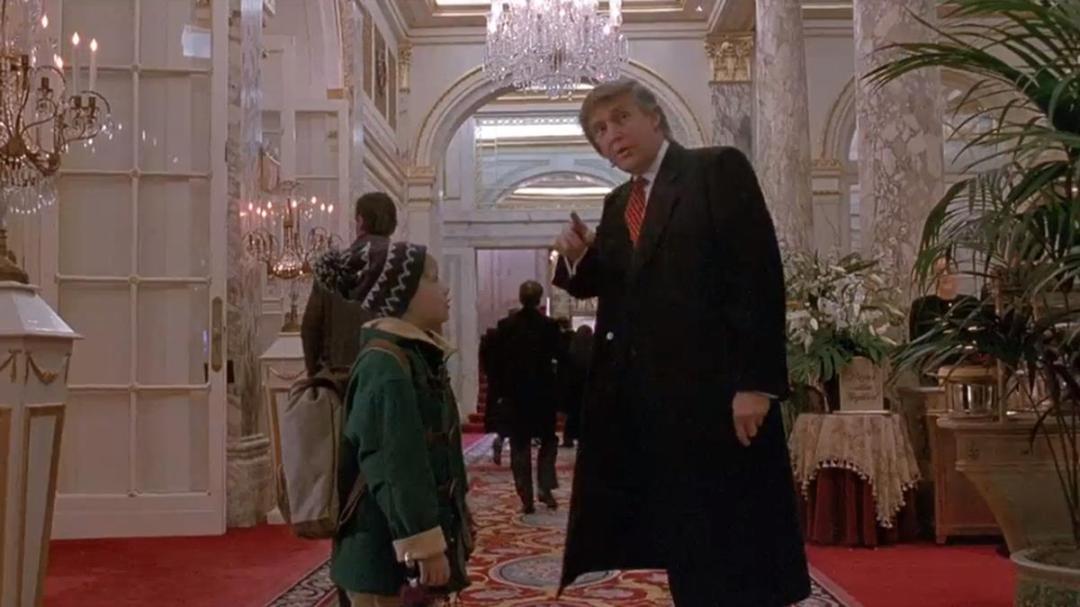
The main character of the film Kevin McCallister in room 411 of the Plaza Hotel.

Soon Trump was forced to sell The Plaza to Prince Alwaleed bin Talal bin Abdulaziz Al Saud at a loss due to financial problems. This member of the Saudi royal family became the penultimate owner of the hotel to date. Four years ago, it passed into the hands of Elad Properties, a division of the Saudi company Elad Group.
By that time, the hotel had not lost its chic, but guests began to enjoy it not so much for its seemingly eternal relevance as for the aura of nostalgia, expressed, among other things, in many places cracking, fading, and generally reminding more of the past than being part of the present. Elad decisively closed The Plaza for a three-year restoration.
The hotel reopened in a somewhat reduced form—part of it, a separate wing with a separate entrance, was converted into a residential building. Alas, all apartments there have already been sold (at prices sometimes reaching, as they say, up to $50 million). However, there is still plenty left for temporary guests. Everything that needed restoration was restored. The new hotel design was overseen by Israeli Gal Nauer, who managed to invent harmony between the former chic and the strict demands of modern comfort. Chic: room furnishings in Louis XV style, fur throws on huge beds, 24-carat gold on faucets, and butlers who appear at any time of day not only at the first call but also wearing mandatory white gloves. Modern requirements led to the appearance of a universal wireless remote control in the rooms, with which you can control everything possible in the room, as well as read the latest news and choose restaurants for dinner. Choosing, however, is not mandatory: all restaurants and bars of The Plaza remain in place, steaks are juicy, cocktails impeccable, and waiters efficient. Also in place is the renovated Grand Ballroom, where the most important New York weddings are still held and the most important birthdays celebrated. A series of pleasant boutiques is being completed and will open any day now, along with a chic beauty salon.
The hotel’s debut in major cinema was in 1959 in Alfred Hitchcock’s film "North by Northwest," which made The Plaza even more popular. The hotel appears in dozens of films from different eras, the most famous of which are: "Brewster’s Millions" (1985), "Crocodile Dundee" (1986), "Home Alone 2: Lost in New York" (1992), "Scent of a Woman" (1992), "Sleepless in Seattle" (1993), "While You Were Sleeping" (1994), "Spider-Man" (2002), "Bride Wars" (2009), "The Great Gatsby" (2013), "The Secret File" (2017), and the TV series The Sopranos.
However, that’s not the main thing. The main thing is what even a small group of curious tourists in shorts can feel when they slip into the cool lobby of The Plaza. Coming here from the hot, ever-rushing, growing in all directions, and speaking all languages city, you can feel in an instant that you are in a different, solid, self-confident, and unhurried New York. One from which everything else in this city follows.
Sources:
https://birdinflight.com/ru/mir/vysshij-bal-samaya-pafosnaya-vecherinka-v-istorii.html
https://www.theplazany.com/history/timeline-history-of-the-plaza-hotel/



Written by Jermaine
Discuss this with the author and others
No comments yet. Be the first to start the conversation.