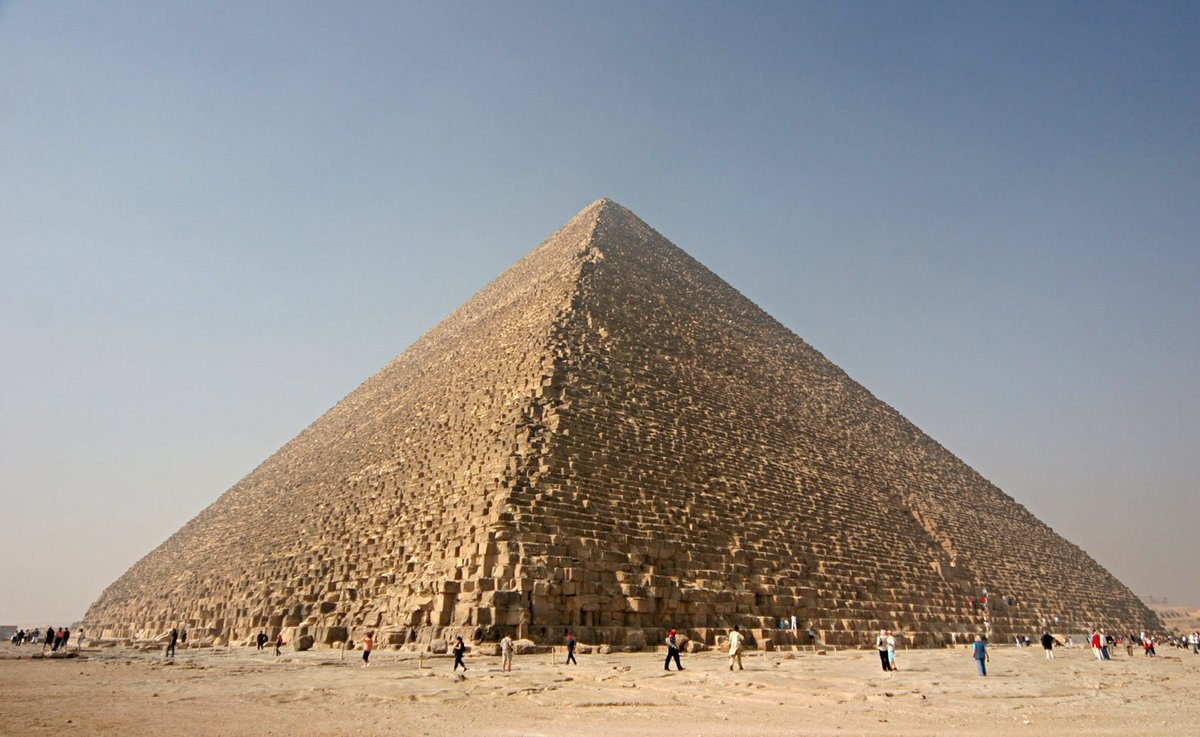

The Great Pyramid of Giza is the largest of the Egyptian pyramids and the most famous landmark of the Giza pyramid complex. It is the oldest of the Seven Wonders of the Ancient World and is the only wonder that has remained largely intact. The pyramid served as the tomb of the Egyptian Pharaoh Khufu, who ruled during the Fourth Dynasty of the Old Kingdom. Built around 2600 BC over a period of about 26 years, it initially stood at 146.6 metres.
Over time, most of the smooth white limestone casing was removed, lowering the pyramid's height to the current 138.5 metres. The dimensions of the pyramid were 280 royal cubits high, with a base length of 440 cubits. The structure was built by quarrying an estimated 2.3 million large blocks, weighing 6 million tonnes in total. While local limestone from the Giza Plateau was used for the core, white limestone from Tura was used for the casing and blocks of granite from Aswan were used for the King's Chamber.
There are three known chambers inside the pyramid. The lowest was cut into the bedrock, while the Queen's Chamber and King's Chamber contain a granite sarcophagus. Hemiunu, Khufu's vizier, is believed by some to be the architect. The pyramid is part of the UNESCO World Heritage Site 'Memphis and its Necropolis'. It was likely looted as early as the First Intermediate Period, and Arab accounts from the 14th century report the discovery of various bodies and treasures inside the structure.
Sources: Wikipedia, OpenStreetMap, Wikidata, Wikimedia Commons

Written by Mutabor
Discuss this with the author and others
No comments yet. Be the first to start the conversation.