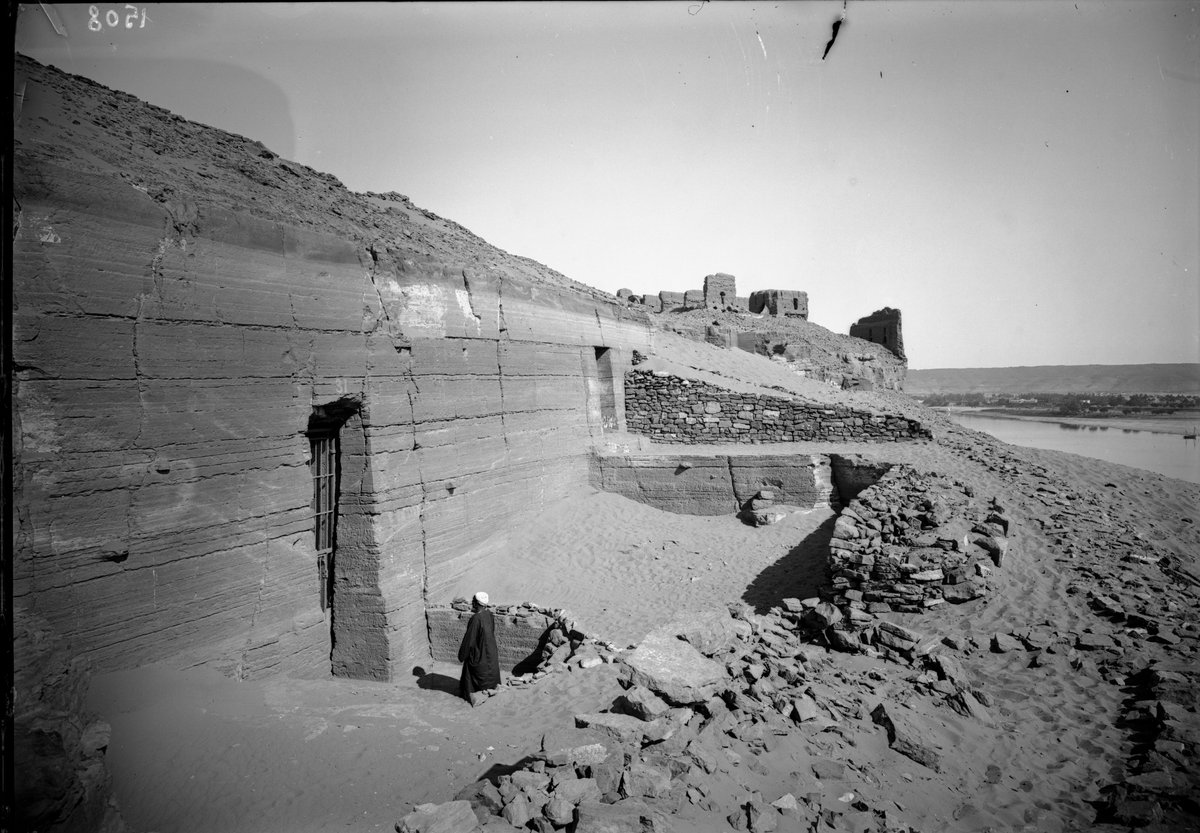
In the tranquil, sun-soaked valleys of the Nile's West Bank, close to the resplendent city of Aswan, rests the age-old burial ground of Qubbet el-Hawa. Among its cluster of rock-cut tombs, three stand out - QH31, QH32, and QH33. Within these sacred sanctuaries, the tales of three souls who once held significant roles in the grand tapestry of ancient Egyptian society echo through time. Let us journey together through these enchanting accounts. As you cross the threshold into the dimly lit tombs, you feel the weight of history - centuries of whispers enveloping you.
These are no ordinary stone structures; they are the royal caskets of long-forgotten pharaohs. Our story begins with the tomb of Sarenput II, QH31. Beloved son of Khema and Satethotep, Sarenput II, a Middle Kingdom nomarch, held great influence in the Province of Elephantine. He bore the titles 'overseer of the prophets of Khnum of Elephantine' and 'commander of the frontier garrison of the Southern Lands. His tomb's walls stand proudly, a tribute to his grandeur, even though the mighty granodiorite statue has been stolen away to the British Museum.
Next is the tomb of Sarenput I, tucked away in QH32. Despite knowing little about this pharaoh, his tomb's discovery has captivated the minds of scholars. They continue to piece together fragments of his life history, a Herculean task given the relics' antiquity. Lastly, we arrive at the tomb of Heqaib II, QH33. Scholars still debate his true identity, but they believe he held a high-ranking government position, perhaps even as vizier. The mysteries of Qubbet el-Hawa remain veiled, yet recent findings hint at more stories waiting to be uncovered.
In 2019, during excavations in Sarenput II's tomb, fragments of polychrome boxes were unearthed. These have since been entrusted to Antonio Morales for study and translation. The University of Jaén's archaeological project continues to delve deeper into the labyrinth of secrets, unveiling the forgotten tales that resound through the annals of time.
Sources: Wikipedia, OpenStreetMap, Wikidata, Wikimedia Commons
Written by Mutabor
Discuss this with the author and others
No comments yet. Be the first to start the conversation.