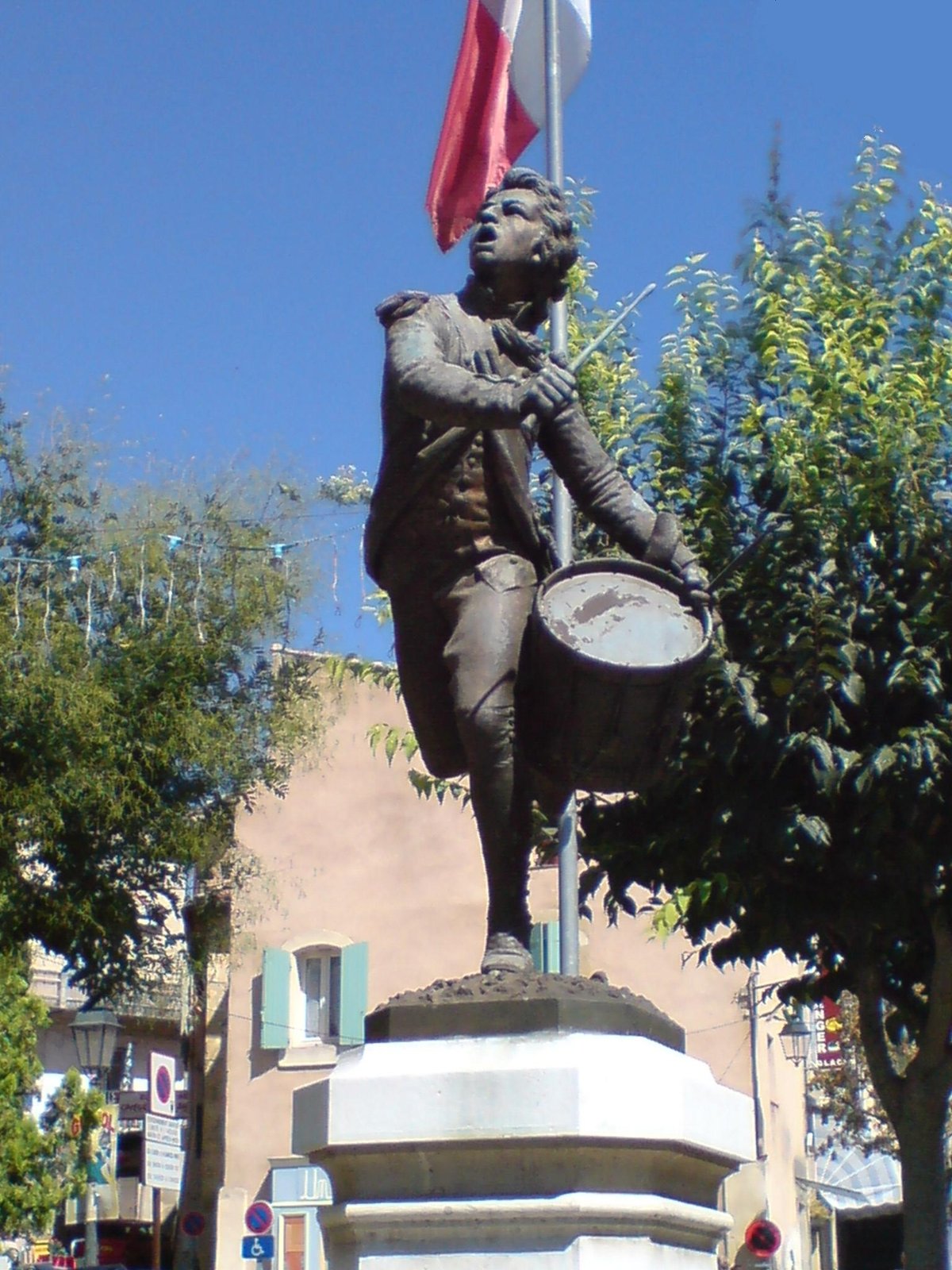

How does a local peasant boy end up on the front of the Panthéon in Paris? It started with a bitter winter in 1792. The Estienne family's olive trees were frozen, and the father’s friend helped the young André join the garde nationale. The prime received as a volunteer allowed his family to meet their needs for a year.
André Estienne became a drummer for the army of Italy. His big moment came on November 16, 1796, at the bridge of Arcole. He did not hesitate to put himself into the water in the middle of the torrent, under fire from the adversary. He received the Légion d'honneur in 1804 and is honored on the fronton of the Panthéon in Paris and on the arc de triomphe de l'Étoile.
Cadenet wanted to immortalize him in 1894. The statue, designed by Jean Barnabé Amy, even features a poem by Frédéric Mistral. But then came the 1940s. The Vichy regime considered melting down the monument as part of the mobilization of non-ferrous metals.
In the night of September 4 to 5, 1943, five people unbolted the statue and buried it in a field belonging to Joseph Roux. The statue was returned to its pedestal in October 1945. You can see it today in the center of the village on the Place du Tambour-d'Arcole.
Sources: Wikipedia, OpenStreetMap, Wikidata, Wikimedia Commons

Written by Nicolo Ciampini
Discuss this with the author and others
No comments yet. Be the first to start the conversation.