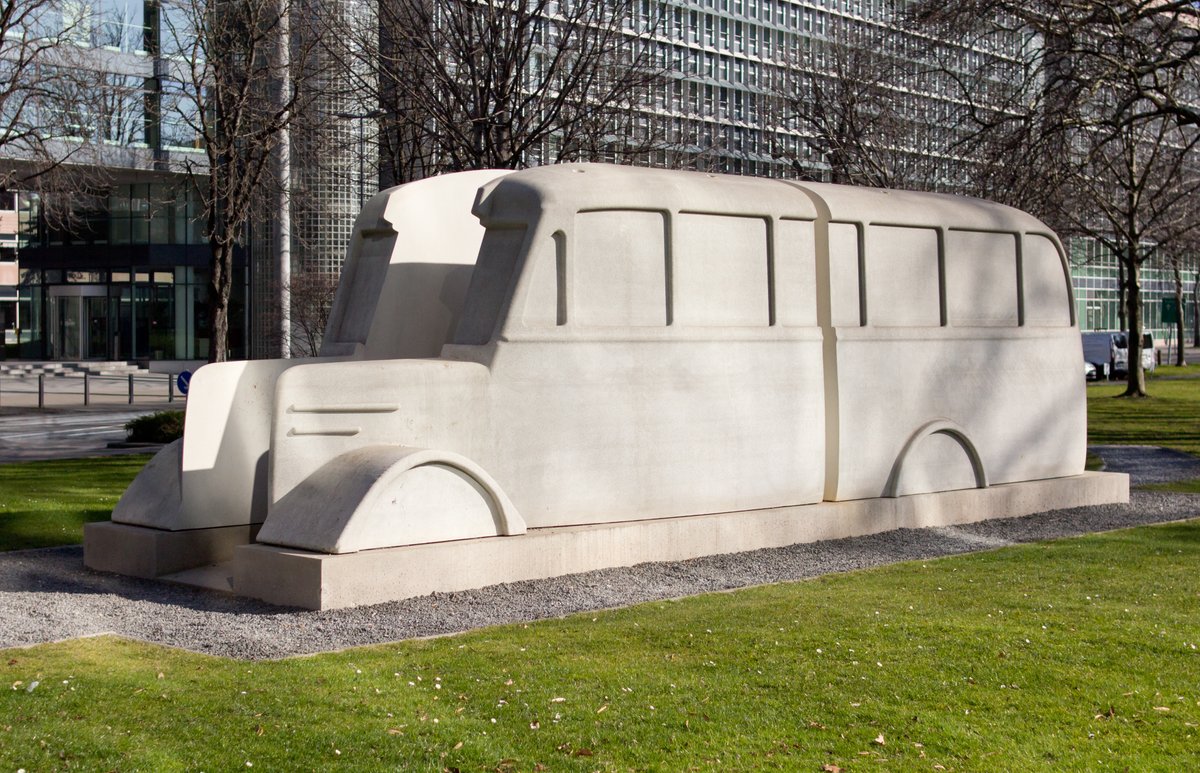
A concrete bus sits at the gate of the Center for Psychiatry Weißenau. It is divided into three distinct lengths, but the center of the vehicle is missing entirely. The void invites the viewer to mentally fill the gap or physically walk through the hollow shell. The memorial is intended as a means of transport of memory to reflect on victims, perpetrators, and the act of murder.
During those two years, the Nazi state carried out 'Aktion T4', a systematic program of euthanasia. From this specific facility in Weißenau, 691 patients were identified as 'life unworthy of life'. They were loaded into buses and deported to the Grafeneck extermination facility. There, in 1940 alone, 10,654 men, women, and children were murdered. Across the rest of Germany, this program claimed the lives of more than 70,000 people who were mentally ill or physically and mentally disabled.
The memorial recreates the Mercedes-Benz O 3750. These were the vehicles used by the Gemeinnützige Krankentransportgesellschaft GmbH, often called Gekrat. While many of the buses borrowed from the Reichspost were originally painted red, they were eventually spray-painted gray. The reason for this color change remains unknown. The sculpture bears a single, haunting inscription: 'Wohin bringt Ihr uns?' (Where are you taking us?). This was the question asked by a man who was picked up by one of these gray buses, a man whose voice echoes among the thousands of others who shared his fate.
Artists Horst Hoheisel and Andreas Knitz designed the memorial in 2005 to serve as a transport of memory. There are three versions of the bus. One fixed sculpture, weighing 70 tons, has blocked the old gate of the asylum since November 2006. A second fixed bus was unveiled at a railway crossing in Hadamar in late 2023. The third version is a mobile memorial that travels to different sites across Germany.
The mobile bus has visited many locations, including the Berliner Philharmonie and the site of a killing center in Brandenburg an der Havel. It stood in Munich and on the banks of the Rhine in Cologne. It even traveled to Zwiefalten because a local nursing institution served as an intermediate camp for the Grafeneck facility. It eventually reached Grafeneck in July 2013 to rest at the site of today's memorial. Today, the stationary concrete bus remains in Weißenau, a permanent interruption in the landscape.
Sources: Wikipedia, OpenStreetMap, Wikidata, Wikimedia Commons

Written by Aurora
Discuss this with the author and others
No comments yet. Be the first to start the conversation.