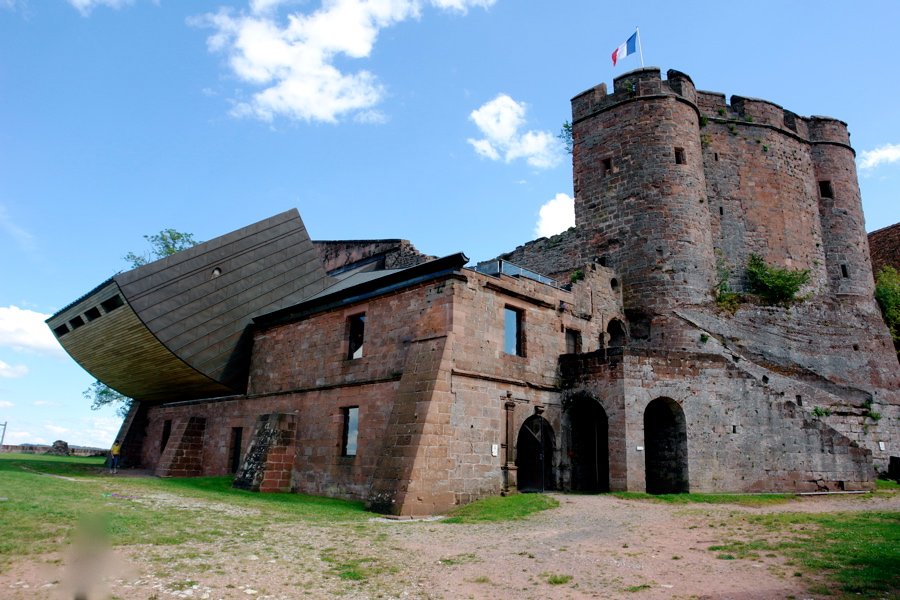

The Château de Lichtenberg, placed in the northern Vosges Mountains, was initially documented in 1206 as the seat of the Lords of Lichtenberg. The Lichtenberg line eventually devolved to the Hanau family, who became the Counts of Hanau-Lichtenberg. In the late 16th century, Philip IV of Hanau-Lichtenberg hired Daniel Specklin, renowned for designing the fortifications of Strasbourg, to fortify the castle against the threat of cannons.
In 1678, the castle surrendered to French forces after an eight-day siege. Like many castles in the Alsace region, it was taken over by the Kingdom of France. On 7–9 August 1870, during the Franco-Prussian War, the Château de Lichtenberg was bombarded by Württemberg troops, which sparked a significant fire that ravaged parts of the castle. The castle was designated a French national historical monument (monument historique) in 1878. However, it remained under German control until the end of the First World War, when it was returned to France.
The castle remained in disrepair until a 52 million-franc (€8 million) restoration initiative was launched in the early 1990s. From 1996, two architects, Andrea Bruno and Jean Pierre Laubal, spearheaded a lengthy restoration effort to restore the antique structures and create a new cultural space for performances and exhibitions.
Sources: Wikipedia, OpenStreetMap, Wikidata, Wikimedia Commons
Written by Nicolo Ciampini
Discuss this with the author and others
No comments yet. Be the first to start the conversation.