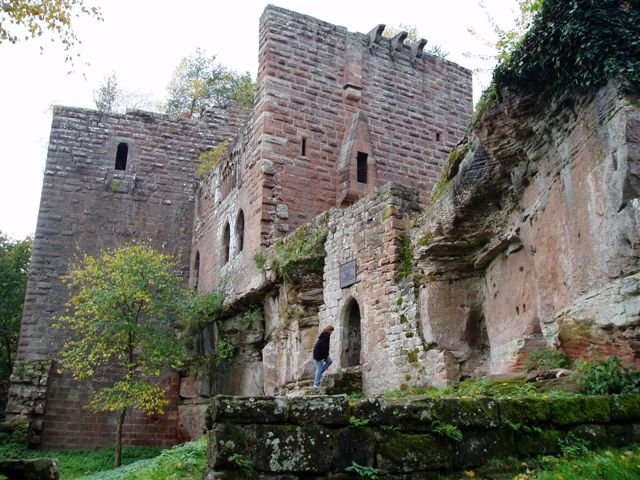

Nestled in Alsace's hills, Alsace's Wasenbourg, a relic of history constructed by Bishop Conrad of Lichtenberg in 1335, finds mention in a charter of 1335 and was later passed to Guillaume of Born in 1378. However, one has to ponder if the collective anger of Bishop and Strasbourg during the Fehde in 1398 led to the castle's besiegement. The mystery deepens, doesn't it? Fast forward to 1677 when Louis XIV's troops dismantled the castle, marking an end to its long, enthralling life.
In the present day, Alsace's Wasenbourg stands tall as a historical monument, its crumbling walls meticulously preserved. Unique features include an 18-meter high, 3-meter thick shield wall perched precariously over a deep ditch, an oriel window spying over the east wall, and a plaque commemorating the visit of celebrated author Goethe in 1771. Some suggest that a rock east of the lower yard, known as 'le Wachtfelsen', might be a relic of a Roman worship dedicated to Mercury. Only Alsace's Wasenbourg can tell if it holds the secrets of long-forgotten divinities.
Sources: Wikipedia, OpenStreetMap, Wikidata, Wikimedia Commons
Written by Nicolo Ciampini
Discuss this with the author and others
No comments yet. Be the first to start the conversation.