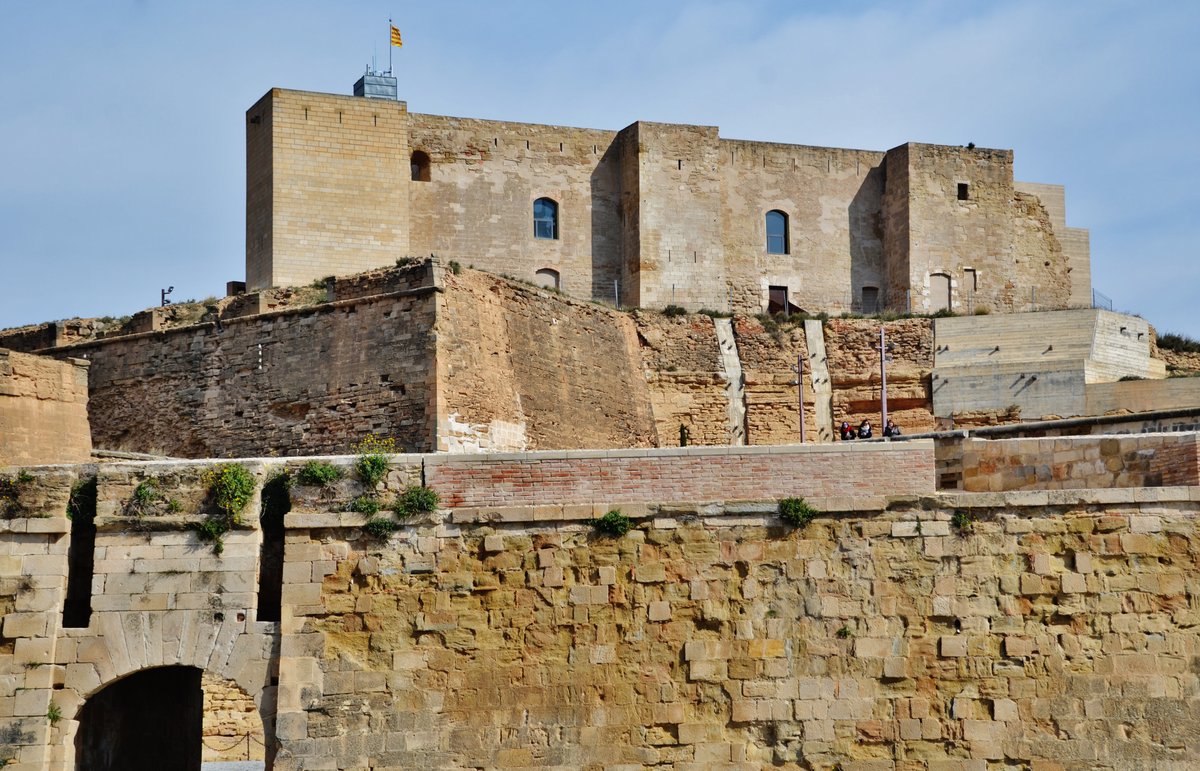

The Castle of La Suda, also known as the Castell del Rei, is a large ruined fortress-palace overlooking the city of Lleida, Catalonia, Spain. The currently visible Romanesque-Gothic complex, dating from the 13th and 14th centuries when it was used as a royal palace, was built over a 9th-century kasbah andalusí. By the main entrance to the fortified complex, the Puerta del León, are the remains of the Roman wall dating to before 26-16 BC.
In 1214, James I of Aragon, then aged six, was recognised by the Catalans and the Aragonese and crowned King of Aragon at the castle. The signing of the Querimonia, by which James II of Aragon granted autonomy to the Aran Valley in 1313, and the Paréages of Andorra, which codified the joint sovereignty over the territory of Andorra, also took place at the palace.
The fortress was used as a military headquarters during the Reapers' War and remained as such until it was demilitarised in 1941. During the War of the Spanish Succession, an explosion in the arsenal destroyed most of the original castle. Although the castle-palace was declared a national monument in 1931, it continued to be used as a military facility until its demilitarisation.
It shares the hill with the Old Cathedral of Lleida, the foundation stone of which was laid in 1203 following the conquest of the Muslim city of Larida in 1149 by the Catalan counts Ramon Berenguer IV and Ermengol VI. On a neighbouring hill, just over a mile away, there is another fortress, the Romanesque 12th-century Gardeny Castle, built by the Knights Templar, and which defends the only accessible side of the castle.
Sources: Wikipedia, OpenStreetMap, Wikidata, Wikimedia Commons
Written by Nicolo Ciampini
Discuss this with the author and others
No comments yet. Be the first to start the conversation.