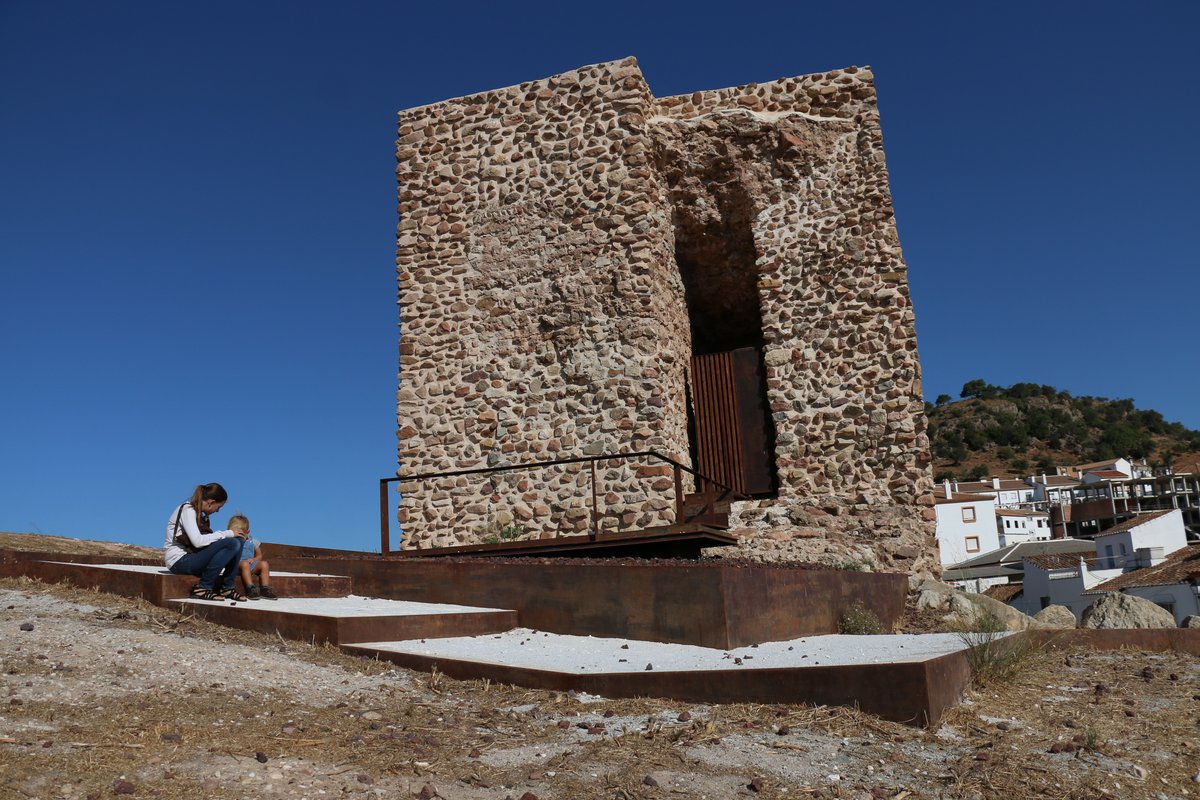

The Castillo de Almogía is a fortification located in the urban center of the town of Almogía in Málaga, Spain. It holds the protection of the Declaration of April 22, 1949, and Law 16/1985 regarding Spanish Historical Heritage. The structure is characterized by an irregular, tending toward oval, layout that dominates the town center.
The fortress consists of masonry walls and a main tower known as the Torre de la Vela. While the specific chronology is not certain without excavation, the materials and techniques used suggest it could date to the Nazarí period. Typologically, the castle shares characteristics with other medieval fortifications from the last period of Muslim occupation, such as those in Alozaina, Casarabonela, Almayate, Tolox, and Yunquera. Due to its geographical proximity, it may also be linked to Cártama.
Significant preserved structures include the main tower attached to the northeast corner, which features worked stones at the corners and interior walls filled with mortar and pebbles. A stepped masonry tower also remains standing on the eastern side. Although the water tank is not visible, records confirm its existence and suggest it is buried underground. While Arab authors do not mention this castle in relation to Almogía, it may have been recorded under a different name.
Today, the castle stands as a Bien de Interés Cultural. Visitors can see the fragments of the perimeter walls that once formed the enclosure. It remains a prominent part of the landscape, offering a physical look at the regional defensive architecture of the medieval period.
Sources: Wikipedia, OpenStreetMap, Wikidata, Wikimedia Commons


Written by Nicolo Ciampini
Discuss this with the author and others
No comments yet. Be the first to start the conversation.