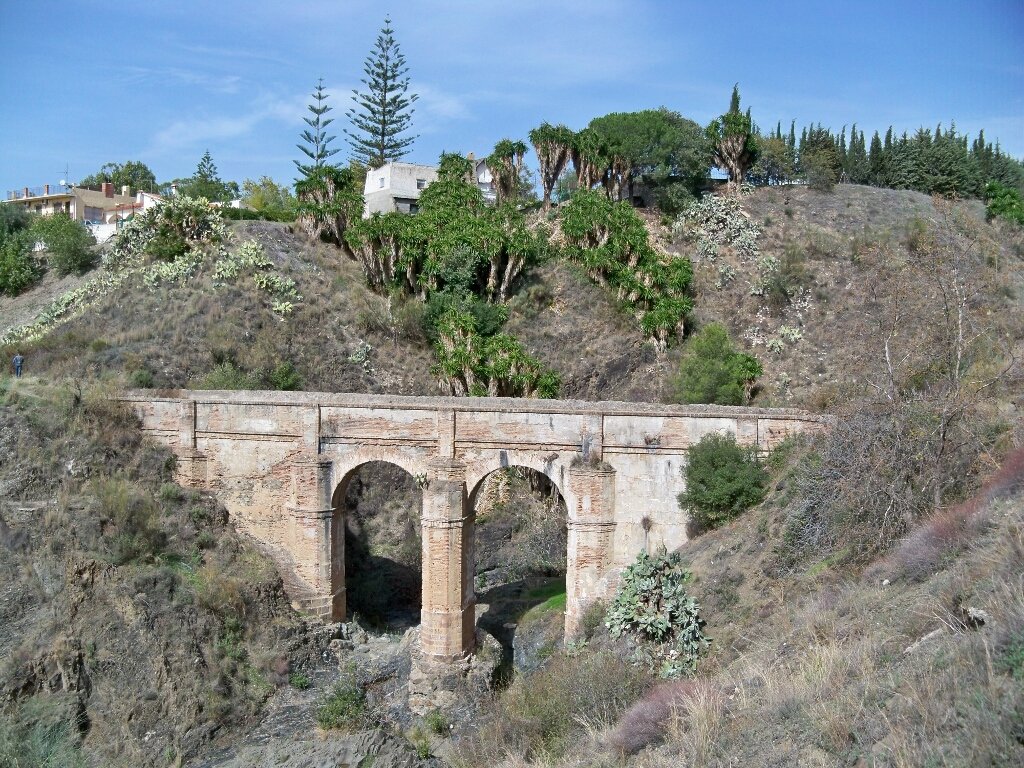

This historical aqueduct, located in the Ciudad Jardín district of Málaga, Spain, showcases remarkable ingenuity and design in its construction. Known as the Acueducto de San Telmo, it is considered one of the most significant hydraulic engineering projects of the 18th century. The aqueduct was designed by architect Martin de Aldehuela and built under the supervision of José de Molina Lario y Navarro, the Bishop of Málaga, who recognized the need for a reliable water source for the city's swelling population and booming economy.
Today, it is well-preserved, with both a covered canal for potable water and an open canal for irrigation. The aqueduct passes through several mines and mills before reaching Calle Refino, with the El Acordeón section, spanning Arroyo Humaina, showcasing one of the most monumental and scenic stretches of the acueduct, spanning 75 meters and standing 15 meters high. Another noteworthy section is the Acueducto de San Telmo, the longest of all, which extends from the water source at San José farm to the urban part near Calle Refino.
The aqueduct is now inscribed as a cultural heritage site, owned by the Foundation Benéfica Caudal y Acueducto de San Telmo.
Sources: Wikipedia, OpenStreetMap, Wikidata, Wikimedia Commons
Written by Nik Frost
Discuss this with the author and others
No comments yet. Be the first to start the conversation.