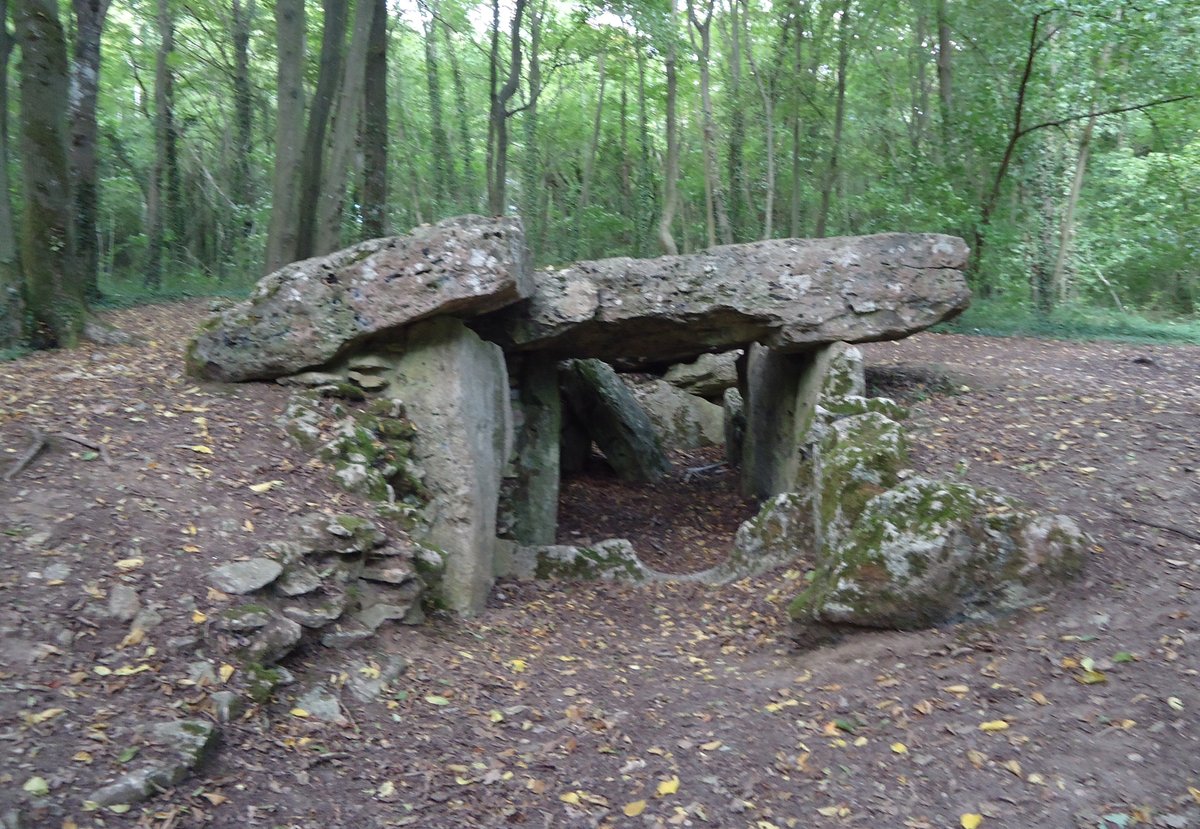

Deep in the woods of La Garenne in Dampsmesnil, France, you'll find an unusual stone circle. This beautiful arrangement of stones, known as an allée couverte, dates back to the Neolithic period, around 2,500 to 2,000 years BC. But this isn't just any allée couverte – this one, unlike most others, has a unique carved decoration. The chamber of the monument is the most striking part, with two supports adorned with female representations – possibly symbolizing the 'death goddess' or funerary goddess, as suggested by other archaeologists.
Similar sculptures have been found on other nearby allées couvertes, such as Bois-Couturier at Guiry-en-Vexin, Pierre Turquaise or dolmen of La Bellée at Boury-en-Vexin, supporting the idea of a common cultural practice or influence. Archaeological excavations have revealed that the monument was reused during the Roman period and was emptied of bones and tools at that time. However, it seems that the megalith was more of interest to treasure hunters than to the Romans themselves.
By the 14th century, the monument had suffered much damage due to stone extraction by quarry workers. Five slabs that once covered the entrance were broken, and one was thrown down the hill. The monument was first described by the Vicomte de Pulligny in 1879, and since then, much effort has been made to preserve this important piece of history. Today, the allée couverte still stands proudly, though it has lost some of its original aesthetics. It is now covered with five slabs, each about 3.8 meters long and 70 to 80 cm thick, placed flat and jointed against each other.
While the allée couverte at Dampsmesnil may not be as grandiose as some other megaliths, it is still a significant testament to the Neolithic era and the cultures that inhabited this region long ago.
Sources: Wikipedia, OpenStreetMap, Wikidata, Wikimedia Commons
Written by Nicolo Ciampini
Discuss this with the author and others
No comments yet. Be the first to start the conversation.