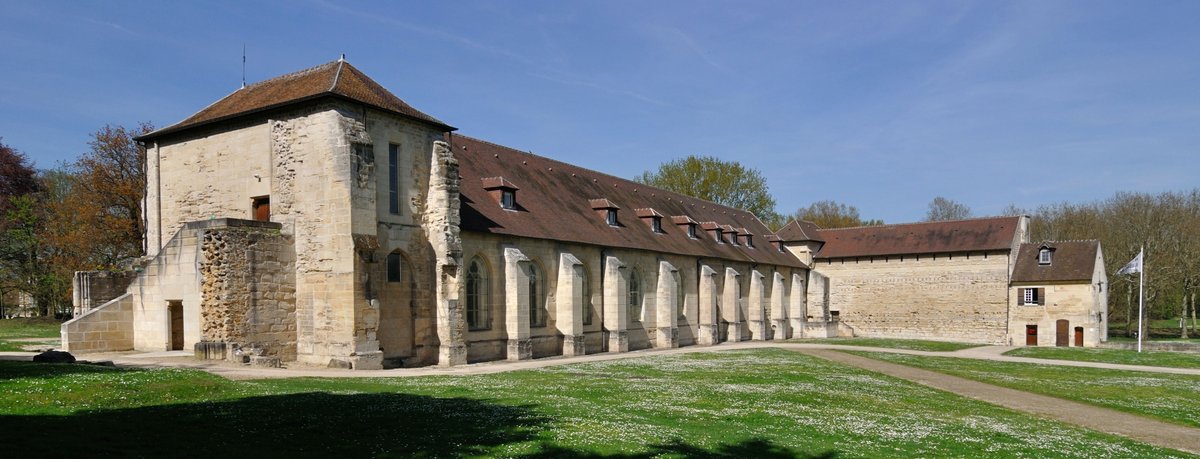

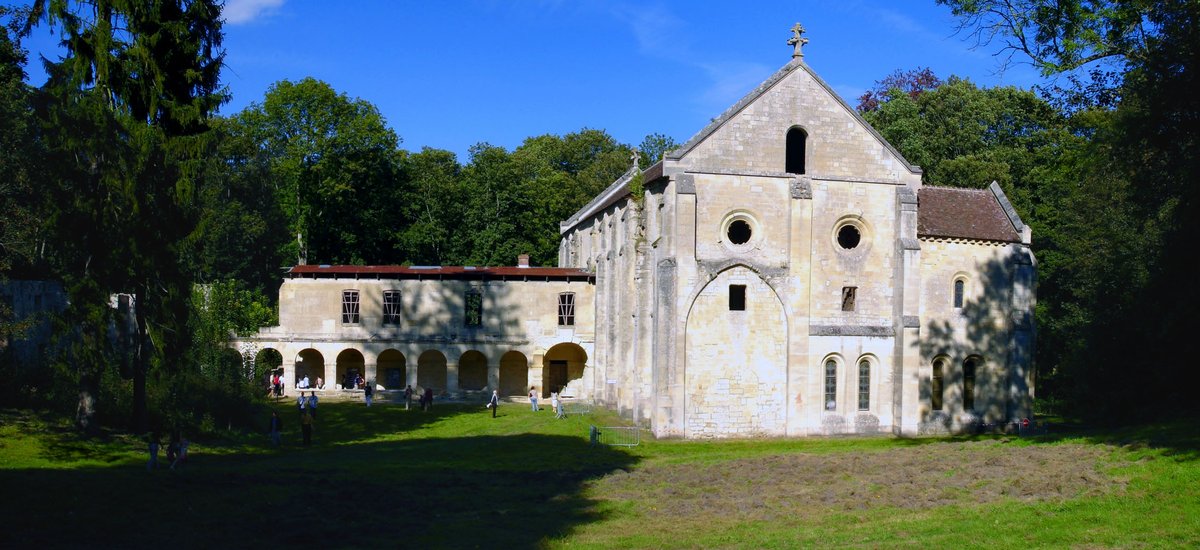
Maubuisson Abbey boasts a chequered past that's brimming with mysteries waiting to be unraveled. It all began in 1236, when Queen Blanche of Castile established the abbey, christening it 'Notre-Dame-la-Royale' in honor of the Virgin Mary. The name 'Maubuisson' has been used from the start. Covering an expanse of 32 hectares (79 acres), the abbey's walls encompass a world of untold stories.
Queen Blanche bestowed the abbey upon a group of nuns from Saint-Antoine in 1242, aligning it with the Order of Cistercians. The abbey's intimate connections with the royal family made it a gathering-place for young noblewomen and a royal necropolis.
Queen Bonne of Luxembourg, Charles V, and Gabrielle d'Estrées were laid to rest within the hallowed grounds of Maubuisson Abbey. In 1307, King Philip IV of France issued a decree from here, launching the trials of the Knights Templar. King Louis XI, during his stay at Pontoise, granted the abbey with Royal protection in 1463 and 1474.
The 16th century saw Maubuisson Abbey buzzing under the guidance of Abbess Antoinette de Dinteville, with 120 nuns residing within its walls. However, the abbey's doctrine diverged from that of the Rule of Saint Benedict and the spirit of Saint Bernard. In 1597, Angélique Arnauld was installed as abbess; François de Sales made several visits to her.
Marie Suireau, alias Marie des Anges, was chosen as the leader in 1628, a position she held until 1648. She fought against the influence of Molinism on some of the sisters, with two nuns suspected of this heresy being ejected to uphold the Cistercian Order's orthodoxy and canons. The abbey continued to attract noteworthy figures, like Louise Hollandine of the Palatinate, and Archbishop Christophe de Beaumont, who made appearances in 1769 to mend relationships within the abbess and her nuns.
The abbey saw a period of decline in the 18th century, with the nun population dipping from 70 in 1720 to merely 18 in 1780. Louis XVI dissolved the abbey in 1786. The abbey was classed as a monument historique in 1947 and came under the control of the Departmental Council of Val-d'Oise in 1979. Archaeological excavations at the abbey took place in the mid-20th century, while restorative works were performed on the tower of the tithe barn in the late 20th century.
The abbey takes part in Tram (Contemporary Art), a federated network of contemporary art producers in Île-de-France, which facilitates dialogue between art practitioners.
Sources: Wikipedia, OpenStreetMap, Wikidata, Wikimedia Commons


Written by Nicolo Ciampini
Discuss this with the author and others
No comments yet. Be the first to start the conversation.