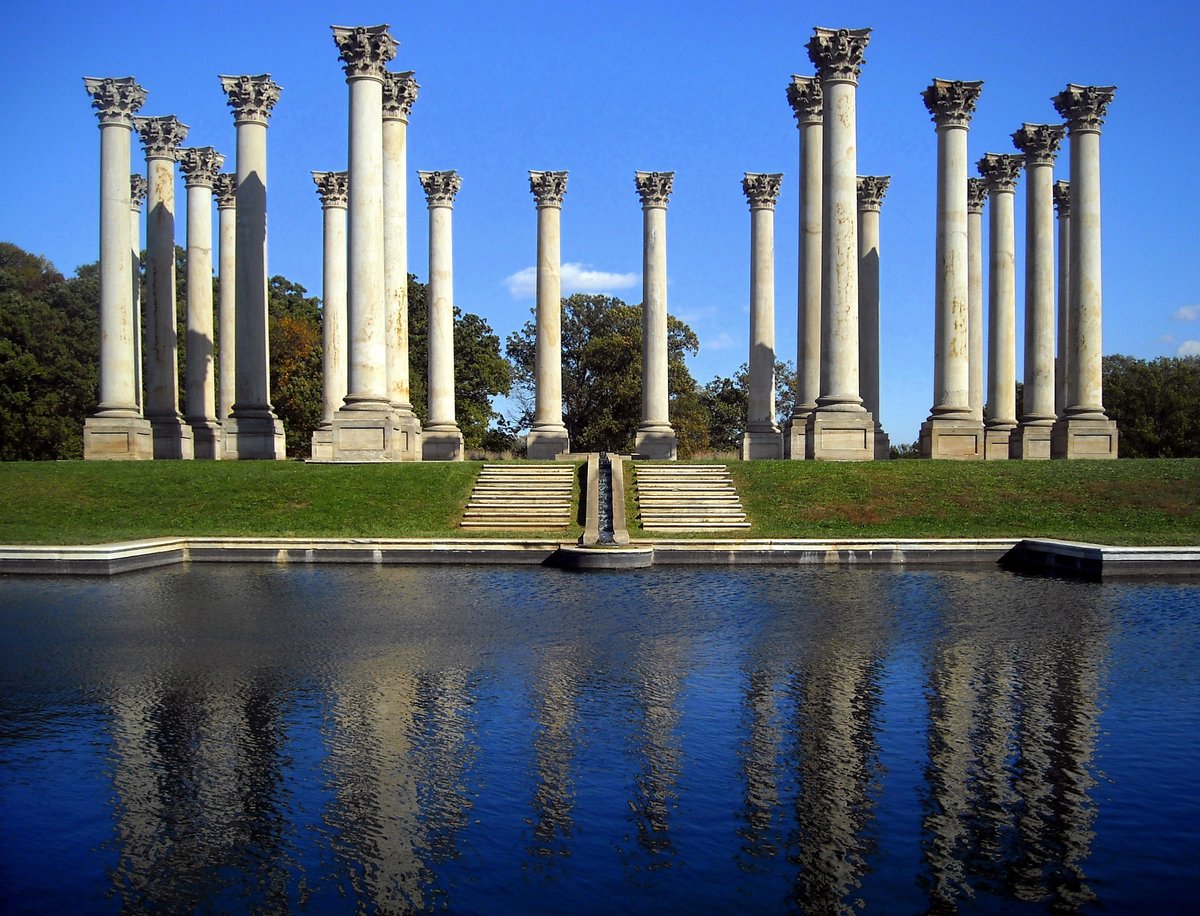
These twenty-two Corinthian columns are monuments in Washington, D.C.'s National Arboretum. They were part of the United States Capitol from 1828 to 1958, but were eventually removed when an addition to the east side of the Capitol was constructed in 1958 to correct a visual illusion.
In 1828, builders hauled these sandstone blocks in from Virginia by barge. They were part of the original plan, but the architects didn't account for the massive iron dome that eventually went up in 1866. The dome was so much bigger than expected that the columns looked woefully inadequate for the job. By 1958, the government built a new addition to the east side of the Capitol and moved the columns to the grass.
In the 1980s, benefactor Ethel Garrett established a permanent home for the columns. Landscape designer Russell Page picked this spot in the Ellipse Meadow in September 1984 because the scale worked for the 20 acres of open meadow available at the site.
You can still see the quarry marks on the stone and the layers of paint from their Capitol days. Only 22 of the original twenty-four columns stand in the Ellipse Meadow; two were so battered they rest at the summit of Mount Hamilton. There is also a detached capital sitting elsewhere in the meadow so that visitors can see the detail of the acanthus leaves that the stone carver incorporated into the design.
Sources: Wikipedia, OpenStreetMap, Wikidata, Wikimedia Commons
Written by Kyle McLonely
Discuss this with the author and others
No comments yet. Be the first to start the conversation.