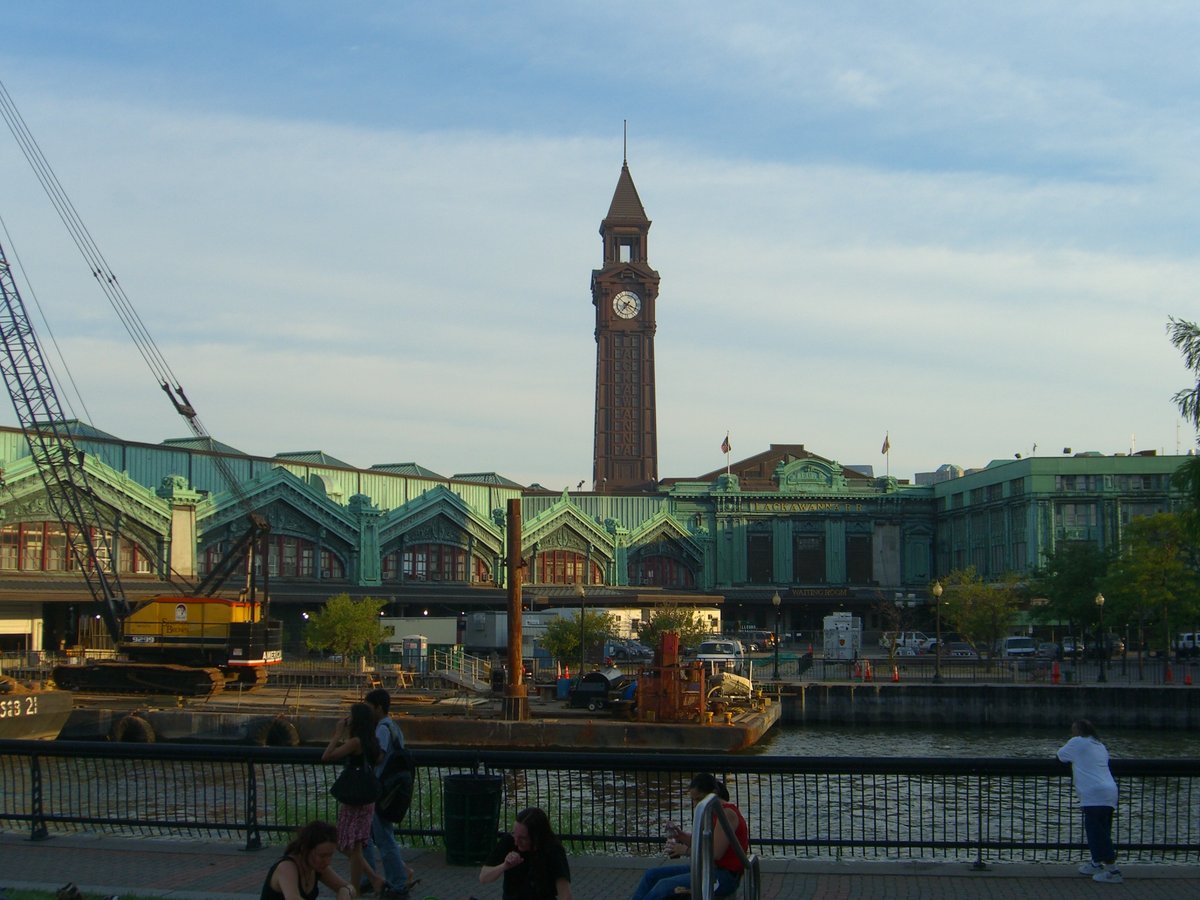
Hoboken Terminal is a commuter-oriented intermodal passenger station in Hoboken, Hudson County, New Jersey. One of the New York metropolitan area's major transportation hubs, it is served by eight NJ Transit commuter rail lines, one Metro-North Railroad line, various NJT buses and private bus lines, the Hudson–Bergen Light Rail, the Port Authority Trans-Hudson (PATH) rapid transit system, and NY Waterway-operated ferries.
More than 50,000 people use the terminal daily, making it the tenth-busiest railroad station in the United States and the sixth-busiest in the New York area. It is also the second-busiest railroad station in New Jersey, behind only Newark Penn Station, and its third-busiest transportation facility, after Newark Liberty International Airport and Newark Penn Station.
The rail and ferry terminal buildings were constructed in 1907 by the Delaware, Lackawanna and Western Railroad. In 1930, Thomas Edison was at the controls for the first departure of a regular-service electric multiple-unit train from Hoboken Terminal to Montclair. One of the first installations of central air-conditioning in a public space was at the station, as was the first non-experimental use of mobile phones.
The terminal features a clock tower standing 225 feet (69 meters) tall. While the tower was replaced by a radio tower for more than half a century, it was replaced with a new clock tower modeled after the original in 2006. The terminal has remained an essential link for New York-bound commuters, surviving threats of demolition through the 1970s.
Sources: Wikipedia, OpenStreetMap, Wikidata, Wikimedia Commons

Written by No Other
Discuss this with the author and others
No comments yet. Be the first to start the conversation.