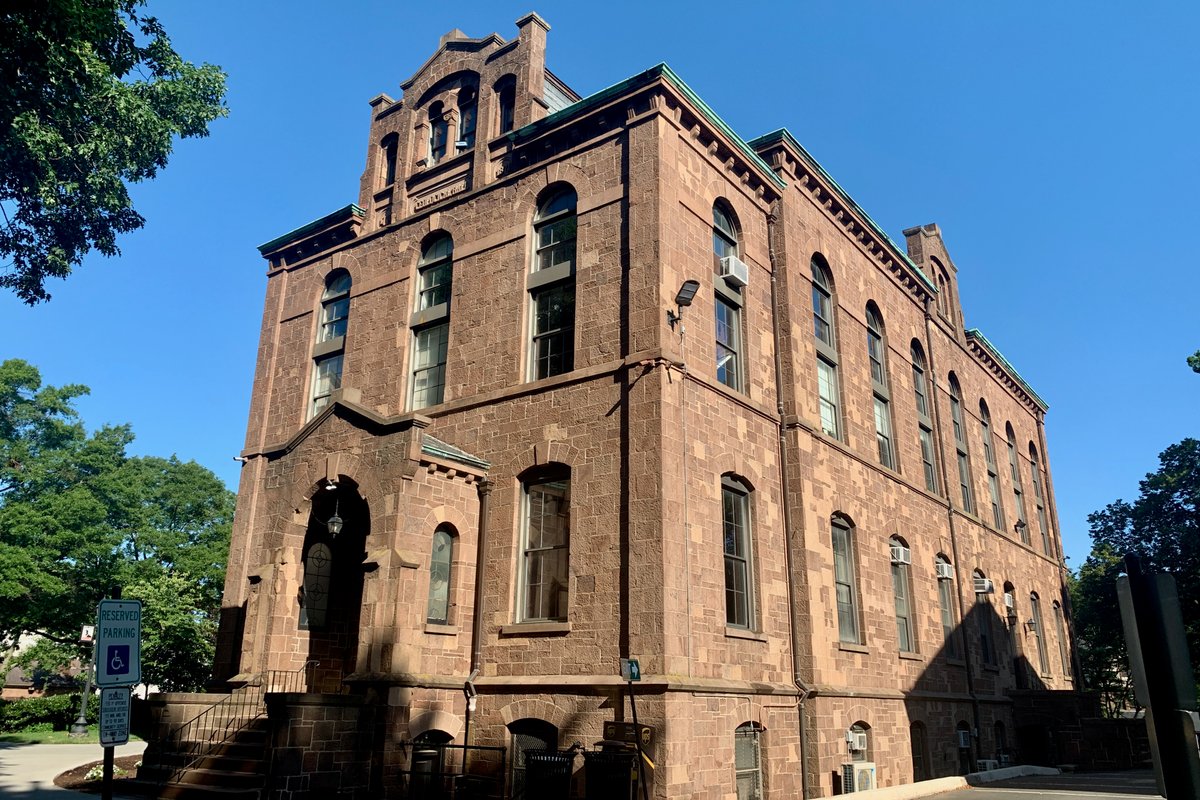
Geology Hall was built between 1871 and 1872 by Henry Janeway Hardenbergh, a descendant of Rutgers' first president. Hardenbergh originally intended to build the hall out of brick but switched to stone late in the planning phase. The architecture employs both Gothic elements and classical forms.
Construction began with a groundbreaking in late April 1871. On June 20, 1871, Governor of New Jersey Theodore Fitz Randolph laid the cornerstone, which contained a time capsule with local newspapers and a history of Rutgers University. The university raised $121,000 in 1870 to support the Scientific School and allocated $63,000 specifically for the construction of Geology Hall.
While the upper floors were designated for the Rutgers Geology Museum, the basement was assigned to the college's military school. In 1875, students from Princeton University stole 25 muskets from this armory in retaliation for Rutgers students stealing a cannon from Princeton.
George Hammell Cook founded the museum here in 1872, though the collection was being gathered since the 1830s. By 1903, the curator was counting 30,000 items, including a mastodon skeleton. The basement was later renovated into educational space in 1912.
By 1977, the Geology Department moved to a different campus. That left the museum as the sole occupant of the building. You can visit today to see the result of over a century of collecting, from the original specimens to the mineralogical pieces acquired from George Rowe, who directed a mine at Franklin, New Jersey.
Sources: Wikipedia, OpenStreetMap, Wikidata, Wikimedia Commons

Written by Kyle McLonely
Discuss this with the author and others
No comments yet. Be the first to start the conversation.