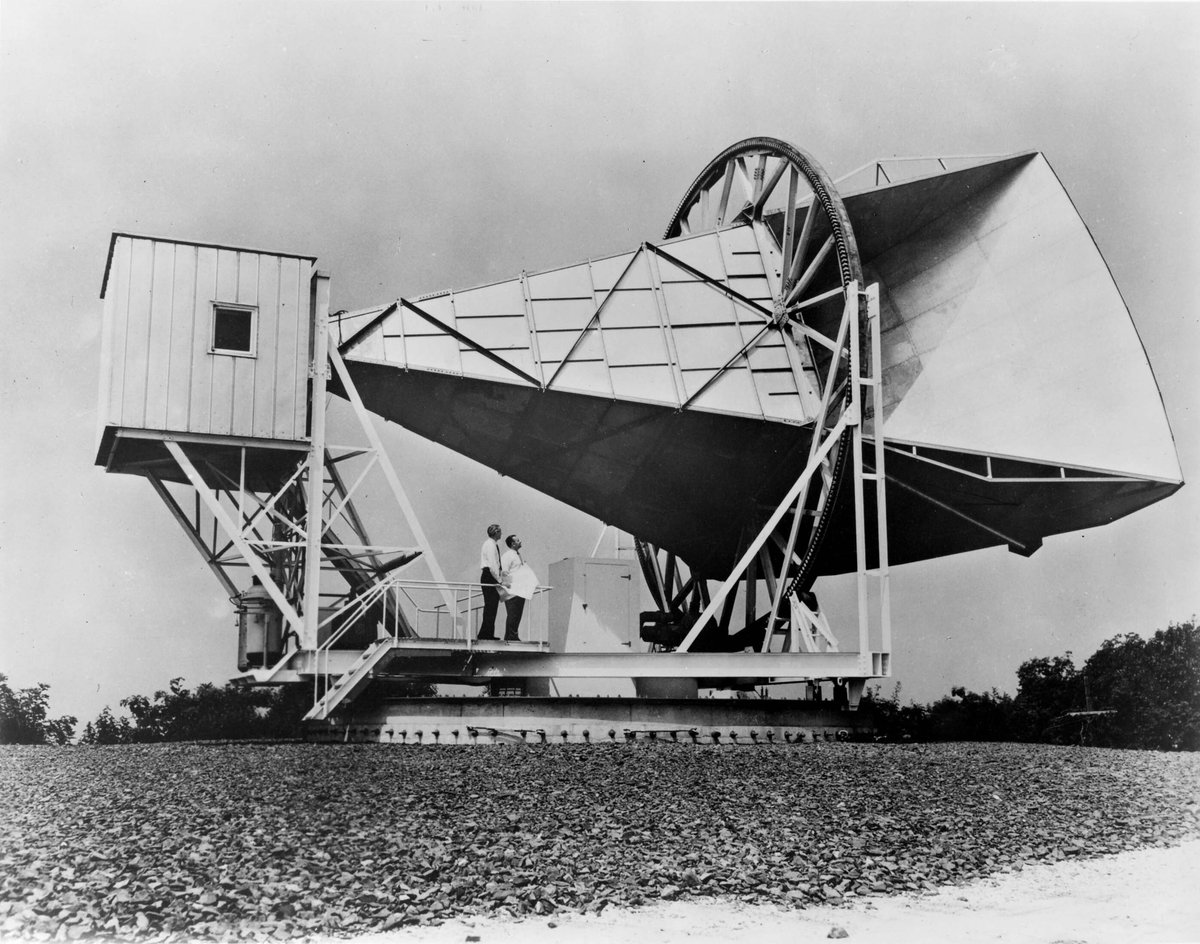

The Holmdel Horn Antenna, located on Crawford Hill in Holmdel Township, New Jersey, is a remarkable piece of engineering history. Once used for satellite communication and as a radio telescope during the 1960s, this microwave horn antenna is now a National Historic Landmark. It is associated with the research work of two radio astronomers, Arno Penzias and Robert Wilson. In 1965, Penzias and Wilson discovered the cosmic microwave background radiation (CMBR) using this antenna.
This discovery, one of the most important in physical cosmology since Edwin Hubble’s work on the expanding universe, provided evidence for George Gamow’s and Georges Lemaître’s Big Bang theory of the universe's creation. The discovery helped change the field of cosmology from theory to direct observation, earning Penzias and Wilson the Nobel Prize for Physics in 1978.
The antenna, constructed in 1959, measures 50 feet in length, with a radiating aperture of 20 by 20 feet. Made of aluminum, it has an aperture efficiency of 76%. The antenna's elevation wheel, surrounding the midsection of the horn, is 30 feet in diameter and supports the structure's weight using rollers mounted on a base frame. All axial or thrust loads are taken by a large ball bearing at the apex end of the horn. The antenna continues through this bearing into the equipment building or cab.
A radiometer for measuring the intensity of radiant energy is located in the cab. The triangular base frame of the antenna is made from structural steel. The antenna rotates around a center pintle ball bearing on a turntable track, allowing the antenna beam to be directed to any part of the sky using the turntable for azimuth adjustments and the elevation wheel to change the elevation angle or altitude above the horizon.
Sources: Wikipedia, OpenStreetMap, Wikidata, Wikimedia Commons






Written by Friendly Jane
Discuss this with the author and others
No comments yet. Be the first to start the conversation.