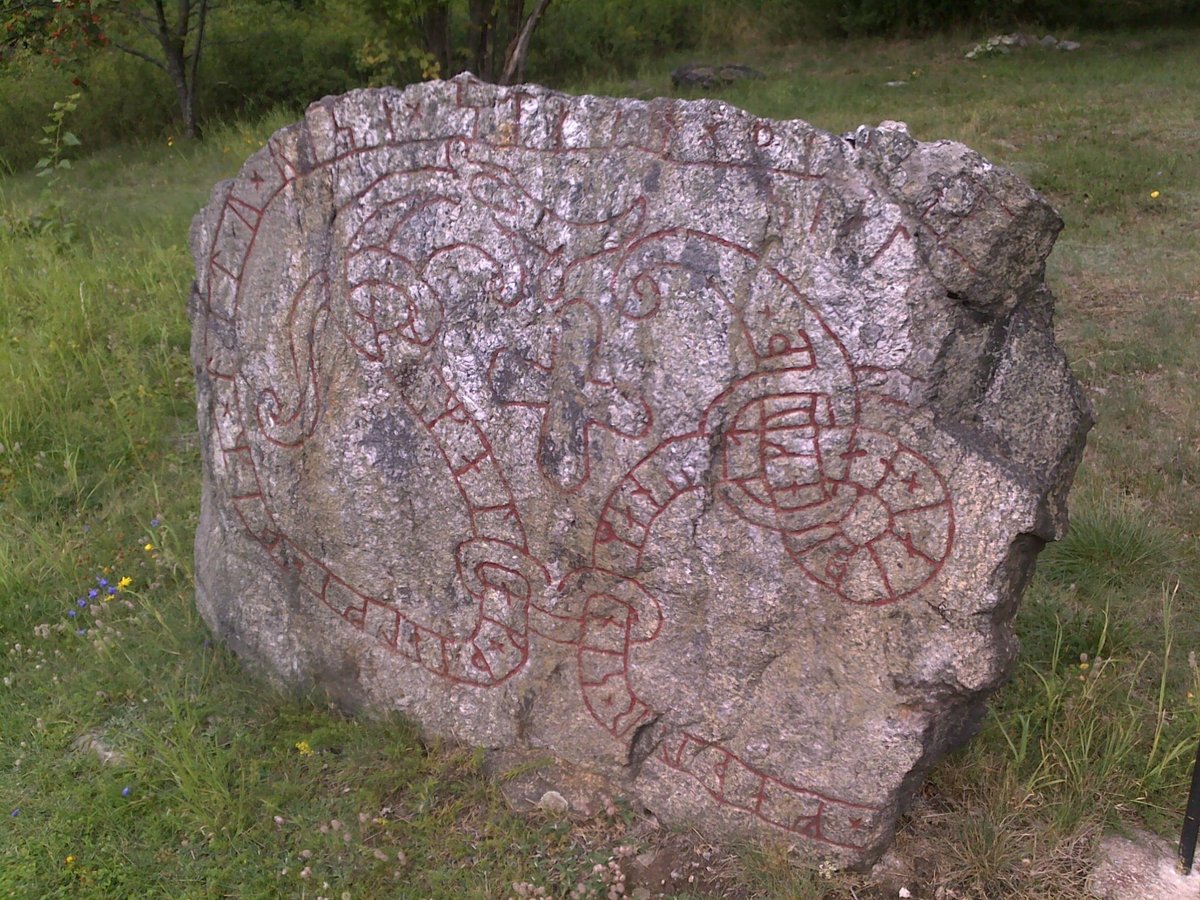

The Glia runestone was erected in the 11th century, likely in memory of a road builder who constructed a "bridge" over the marshland between Linta village and Glia village. The text on the stone indicates that those who raised it were Christians. According to Nils Ringstedt, the capable man mentioned in the inscription may have been the one who took the initiative to build the old Gliavägen, a road that dates back to prehistoric times.
The stone, known as Gliastenen with the signum U56, is currently located at Kvarnbacksvägen in the Riksby district of Bromma. It was first discovered by the researcher and runologist Johan Hadorph on May 14, 1682. Hadorph was on a mission with Johan Peringskiöld to record old monuments, and his notes identify the stone as being found at Glia grind, near the western edge of Ålsunda.
Originally situated at the Glia burial ground along the old Gliavägen, the stone was moved to its current location near the Linta burial ground in 1951. It was placed there because runestones were often situated in spots where they could be seen by travelers. Today, it stands as a record of a man described as "capable," with the inscription concluding with a prayer for his soul.
Sources: Wikipedia, OpenStreetMap, Wikidata, Wikimedia Commons




Written by Nik Frost
Discuss this with the author and others
No comments yet. Be the first to start the conversation.