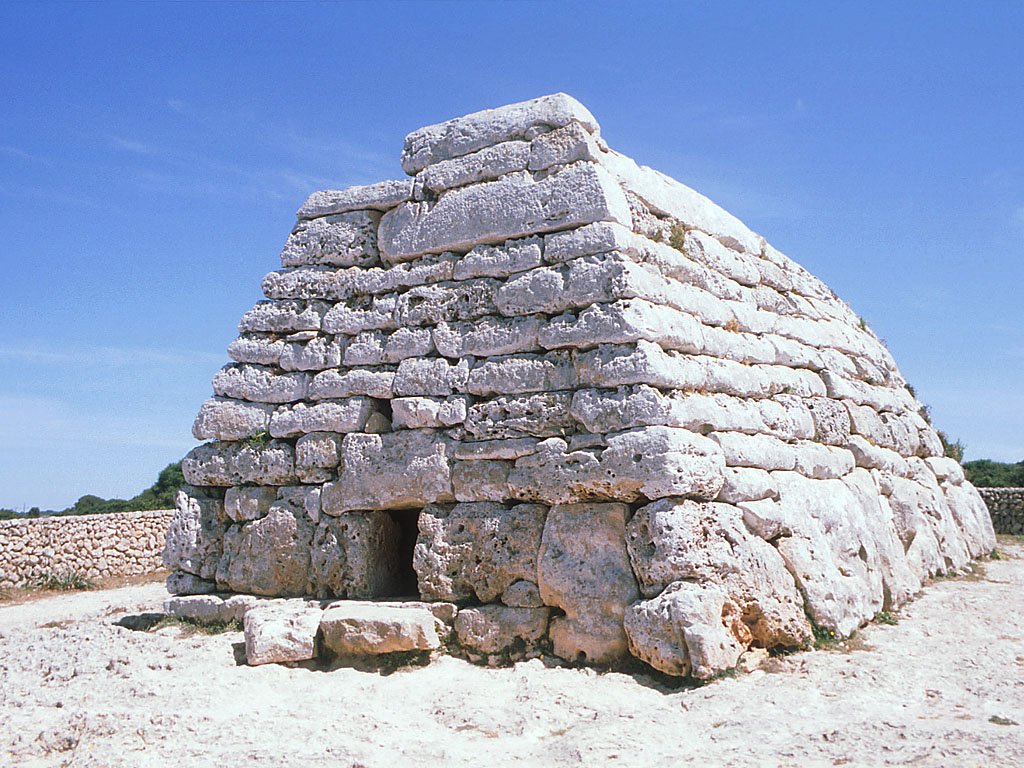

The Naveta d'Es Tudons, or Naveta of Es Tudons, is the largest and best-preserved funerary naveta in Menorca, one of the main tourist attractions of the Balearic Islands. This small architectural wonder, found on the road leading from Ciutadella de Menorca to Mahón, served as a collective burial vault between 1200 and 750 BC, longer than any other megalithic tomb on the island. Though nothing is known about the people who built it, it is certain that they had a specific way of burying their dead.
The tomb has two chambers – the lower one was where they stored the disarticulated bones after fleshing them, while the upper chamber was used for post-mortem dehydration. Archaeologists estimate that the Naveta d'Es Tudons, which originated during the Talayotic period (1850-580 BC), was buried around 1130-820 BC. In 1959-1960, historian Lluís Pericot García excavated and restored the Naveta d'Es Tudons, and it was registered as a Spanish national heritage site in 1931.
Today, you can see some of the recovered objects - bronze bracelets, bone buttons, and ceramics - on display at the Museu de Menorca in Mahón. The Naveta d'Es Tudons has a boat-like shape, with a trapezoidal facade and a rounded apse. The ground plan is an elongated semi-circle, and the tomb originally stood over 6 meters tall. The entrance is a narrow, low doorway at the southwest.
Sources: Wikipedia, OpenStreetMap, Wikidata, Wikimedia Commons
Written by Nik Frost
Discuss this with the author and others
No comments yet. Be the first to start the conversation.