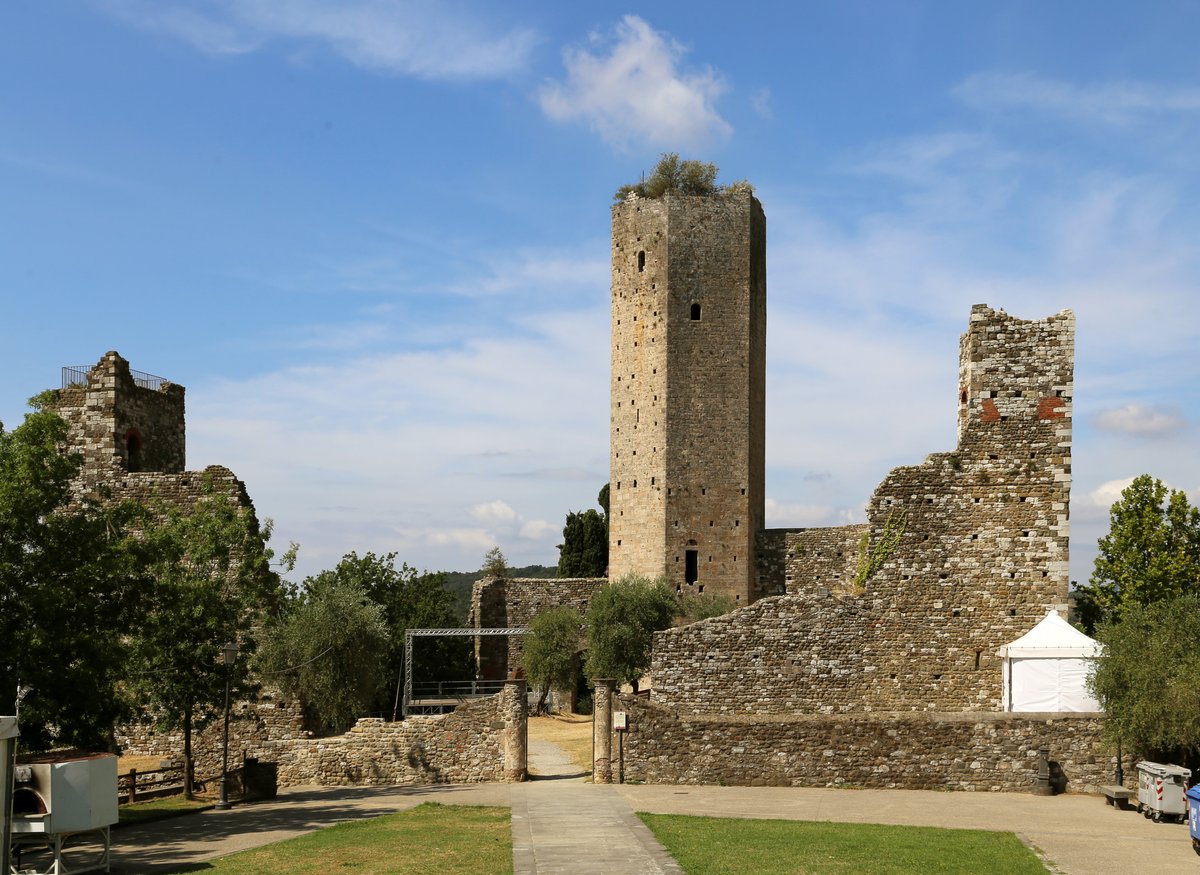
**Rocca Nuova**, also known as **Rocca di Castruccio**, sits at **Serravalle Pistoiese, Italy**. This historic building, once a castle, now serves as an attraction, showcasing the region's intricate history dating back to the early 14th century. Built by the forces of the **Republic of Lucca**, the fortress was constructed to counter the alliance between Lucca and Florence and the city of Pistoia.
### History The origins of **Rocca Nuova** can be traced back to the early 1300s. During this time, Lucca formed an alliance with Florence to challenge the control of Serravalle Pistoiese held by Pistoia. This conflict led to a prolonged siege, lasting approximately three months. Initially, around 300 men from Pistoia, supplemented by 100 mercenaries from Bologna, defended the fortress using trebuchets and palisades in a tenacious defense. However, the Pistoian forces eventually surrendered to the Republic of Lucca, increasing the latter's dominance over the area.
Following the conquest, the Republic of Lucca prepared for potential uprisings from the local population once their troops withdrew. As such, they constructed a new fortress, named **Rocca Nuova**, around 1302. This new stronghold was deliberately built alongside but distinctly separated from the older castle, known as **Rocca Vecchia**. This historical development reflects the strategic importance attributed to the site, as well as the evolving political and military needs in the region.
**Castruccio Castracani**, a notable Luccan lord, played a pivotal role in the completion and reinforcement of Rocca Nuova. Prior to Castracani’s involvement, early construction and strengthening efforts were undertaken by **Uguccione della Faggiola**, another key military leader. The fortress, with its robust limestone walls and observation posts, served as a testament to the military architecture of the early 14th century.
Sources: Wikipedia, OpenStreetMap, Wikidata, Wikimedia Commons
Written by Nicolo Ciampini
Discuss this with the author and others
No comments yet. Be the first to start the conversation.