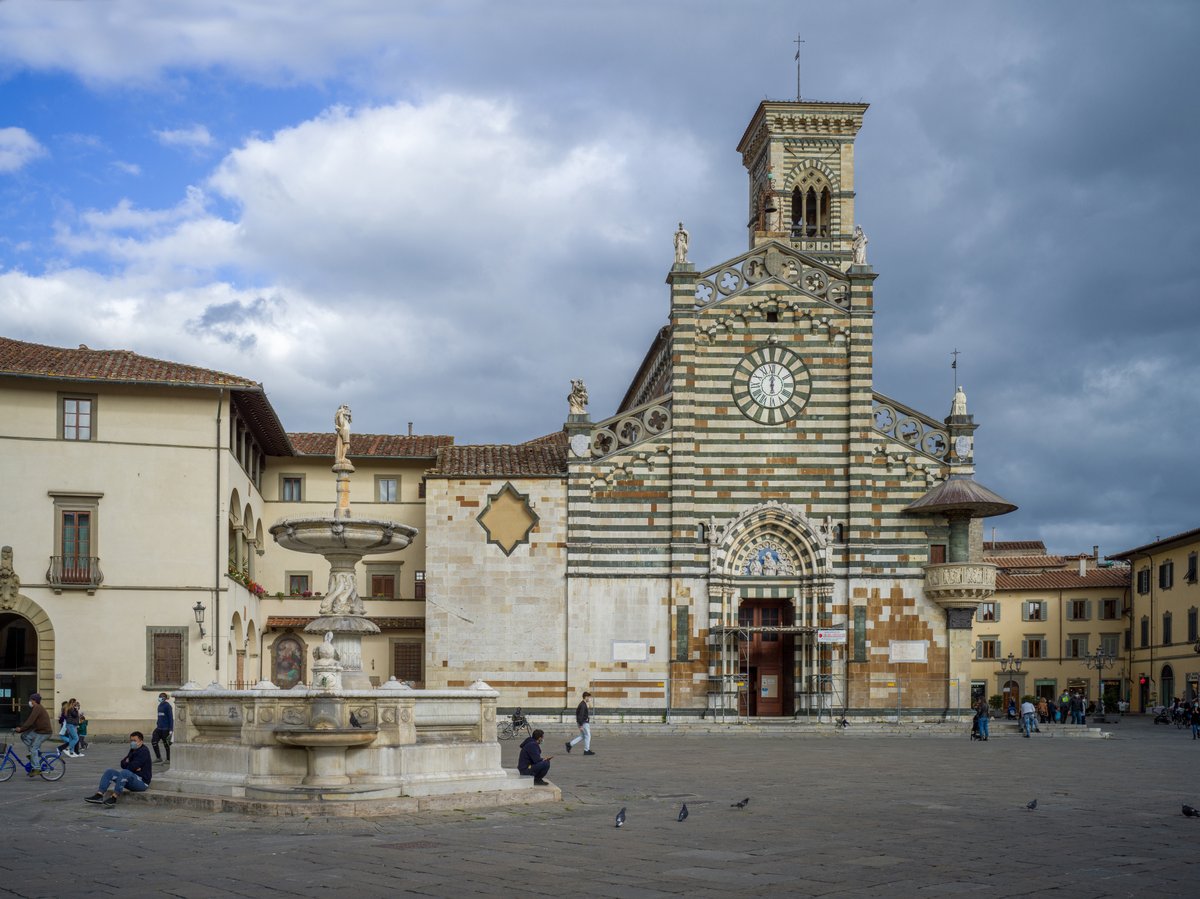

During the 14th century, the Cathedral of Saint Stephen in Prato acquired an important relic known as the Sacra Cintola, or the Belt of the Holy Virgin. This acquisition brought about a significant enlargement of the edifice through the addition of a transept. The transept is attributed to Giovanni Pisano, but it is probably the work of a pupil of Nicola Pisano. A Cintola Chapel was also built at this time to house the relic.
A substantial expansion of the church building began in the 15th century, enlarging the nave and aisles, and erecting the bell tower, which was completed in 1356. This work transformed the modest building into the Gothic-Romanesque structure seen today. The facade, added in the early 15th century in the International Gothic style, features a central portal with a lunette containing a glazed terracotta sculpture by Andrea della Robbia.
Internally, the church follows a Latin cross ground plan with a nave and two side aisles in Romanesque style dating from the early 13th century. These are separated by columns of green serpentine with capitals attributed to Guidetto. The north aisle houses a notable Renaissance pulpit in white marble from 1469–1473, decorated with sphinxes and reliefs by Antonio Rossellino and Mino da Fiesole. The original reliefs were moved to the cathedral museum in 1967.
The chancel contains frescoes by Filippo Lippi and Fra Diamante depicting the Stories of St. Stephen and St. John the Baptist. Lippi included a self-portrait on the north wall. Other notable works include the 15th-century Renaissance frescoes by a young Paolo Uccello in the Assumption Chapel and a 13th-century Deposition of Christ in the Vinaccesi Chapel.
Sources: Wikipedia, OpenStreetMap, Wikidata, Wikimedia Commons
Written by Nicolo Ciampini
Discuss this with the author and others
No comments yet. Be the first to start the conversation.