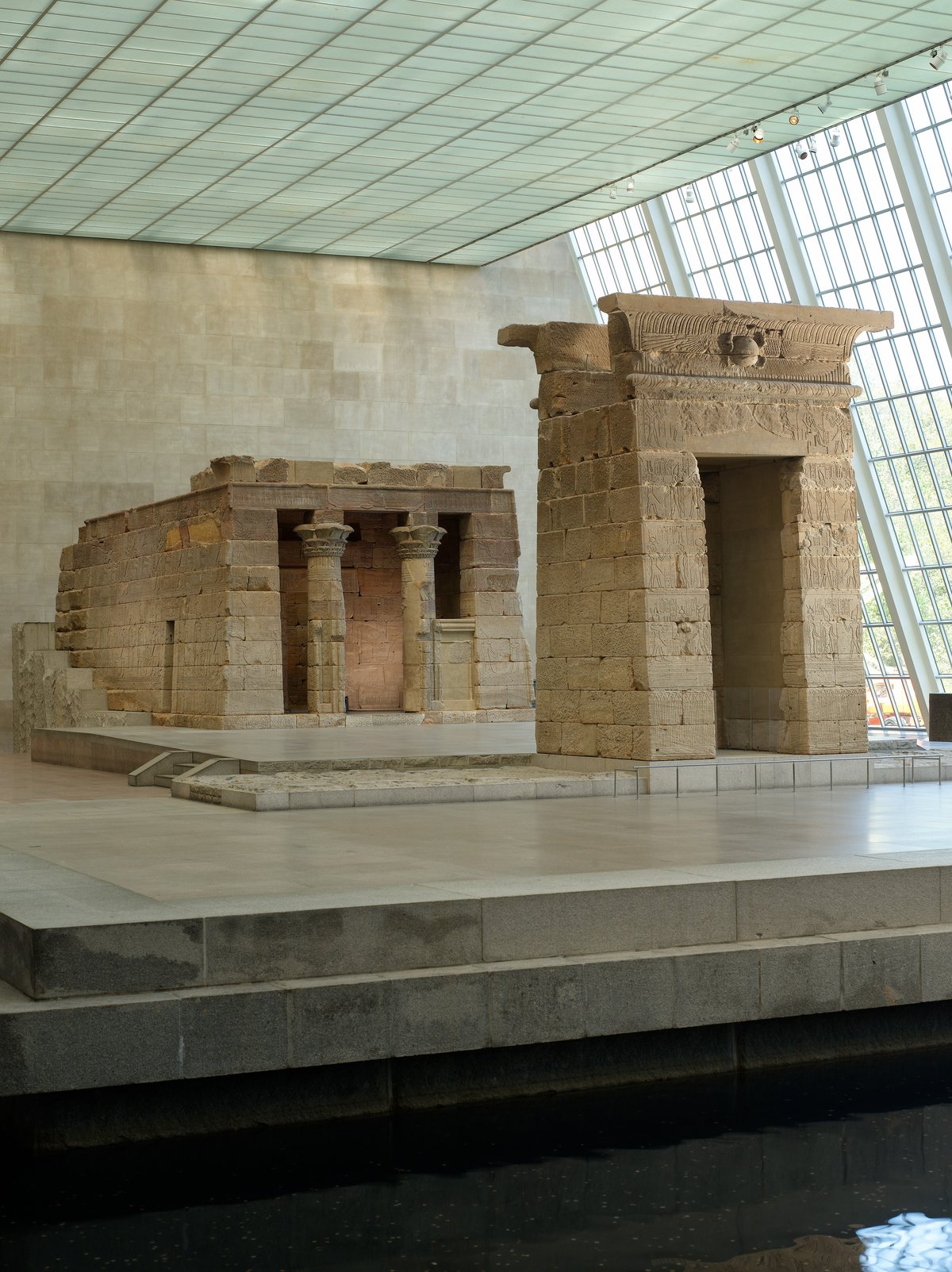

The Temple of Dendur is an ancient religious structure originally located in Tuzis, about 80 kilometres south of modern Aswan. Built between 23 BCE and 10 BCE, the temple was commissioned by the Roman Emperor Augustus at the request of Petronius, the governor of Egypt. Dedicated to the goddess Isis and the local cult of Pedesi and Pihor, the temple was used by Augustus to legitimize his rule. Local people visited the temple to bring gifts of incense, wine, and food, which they believed nurtured their ruler and ensured their own prosperity.
In the 1960s, the construction of the Aswan High Dam threatened to permanently submerge the temple. As part of the International Campaign to Save the Monuments of Nubia, UNESCO and fifty other countries collaborated to rescue the site. Egypt eventually gave the temple to the Metropolitan Museum of Art in New York City. The museum chose to house the structure in a space where they could replicate the high temperatures and dry climate of Egypt to preserve the sandstone blocks.
Moving the temple was a massive undertaking that cost $9.5 million and was supported by Lila Acheson Wallace. The structure, which consists of 661 sandstone blocks weighing 640 tons, was dismantled, packed into crates, and transported to New York by the freighter SS Concordia Star. After the blocks arrived in 1968, conservators and stonemasons began reconstructing the temple in 1975. It officially opened to the public in 1978. Architect Kevin Roche designed a display case for the temple that is described as being as successful as the tiny temple itself.
The temple features a modest but well-executed design, standing 13.0 metres long and 6.6 metres wide. It was constructed by local Egyptian architects using millennia-old methods and traditional aesthetics. The entrance features a monumental pylon known as the Luminous Mountain Horizon, decorated with relief carvings, and a processional way that leads to the temple building.
Sources: Wikipedia, OpenStreetMap, Wikidata, Wikimedia Commons

Written by Friendly Jane
Discuss this with the author and others
No comments yet. Be the first to start the conversation.