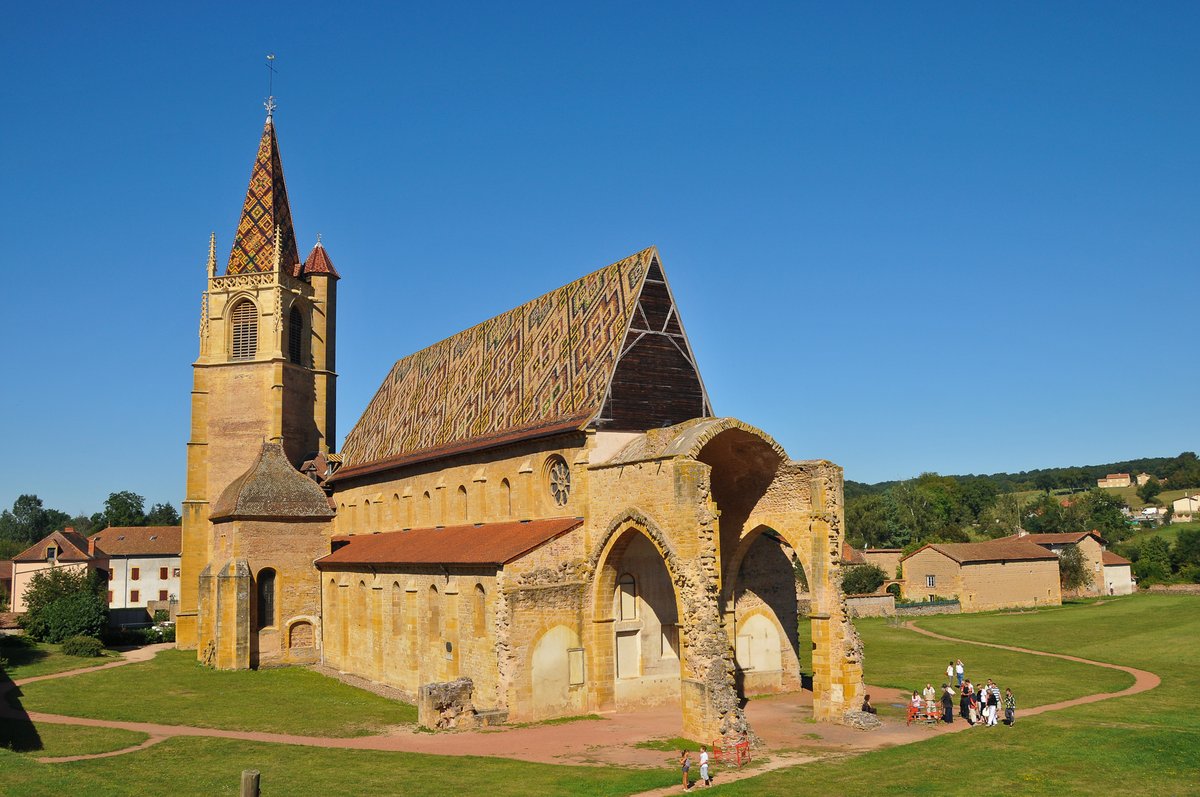

In 1138, Albéric, a disciple of Bernard de Clairvaux, founded the Cistercian abbey of La Bénisson-Dieu in the Loire department. Accompanied by twelve monks, he chose this site on the banks of the Teyssonne for its calm, its water, and its land for clearing. This reflected the Cistercian ideal of a simple life centered on work and prayer.
Around 1500, the abbey was managed under the form of a commende. During this time, Pierre de La Fin added a fortified bell tower and a spire overlooking the choir. Significant changes occurred again in 1612 when the monastery, ruined by wars, became an abbey for women. Under the leadership of Françoise de Nérestang, the ruined site was restored and remodeled, featuring a baroque chapel completed in 1651. This chapel was dedicated to the Virgin Mary and served as a mortuary for the Nérestang family.
Today, only the church remains. It illustrates the transition between Romanesque and Gothic styles and features a 51-meter-high bell tower added in the late 15th century. The roof is covered with multi-colored glazed tiles in the Burgundian fashion. Inside, the first sacristy displays 17th-century paintings of bucolic landscapes and castles, while the chapel de Nérestang contains sections of black and white marble.
Sources: Wikipedia, OpenStreetMap, Wikidata, Wikimedia Commons
Written by Nicolo Ciampini
Discuss this with the author and others
No comments yet. Be the first to start the conversation.